Swedish Minister of Migration Johan Forssell visits MIT on Jan. 13
Forssell: “We need to increase the inflow of highly skilled people”





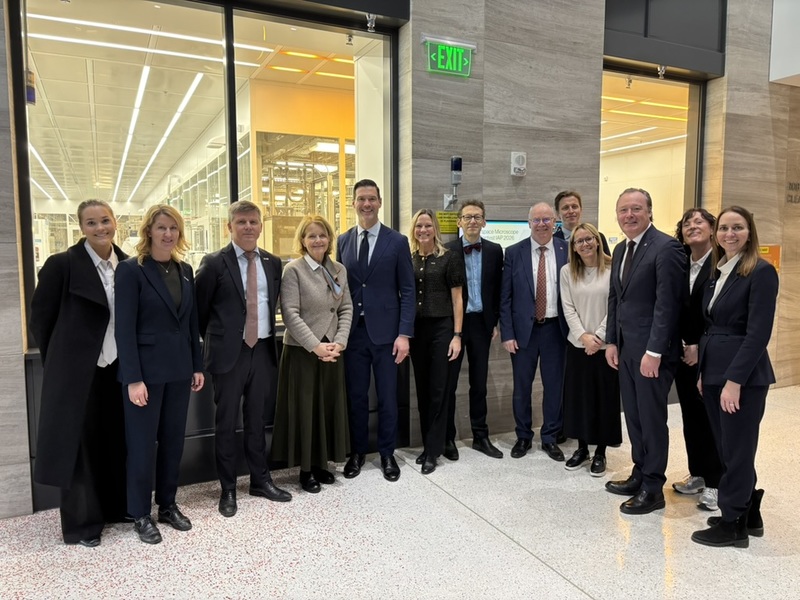
Vivian Hir–The Tech
From Jan. 12 to 13, Swedish Minister of Migration Johan Forssell visited Boston and Cambridge with a delegation of leaders from six major universities in Sweden, including the Karolinska Institutet and Uppsala University. During the trip, the delegation met with representatives from MIT and Harvard, state representatives, and business organizations such as the Kendall Square Association. They hoped to build new collaborations with American research leaders in industry and higher education, thus gaining insights into Sweden’s domestic research.
A member of the center-right Moderate Party, Forssell has focused on increasing the share of highly skilled immigrants in Sweden while significantly reducing the number of asylum seekers and refugees. Forssell has also prioritized integration, emphasizing the importance of learning the Swedish language and becoming part of Swedish society. These new policies reflect a major shift in Sweden’s international reputation, from a nation known for welcoming refugees to one seriously limiting asylum seekers.
In an interview with The Tech, Forssell discussed the Swedish government’s wish to strengthen its research sector and increase the number of highly skilled immigrants. In addition, Forssell shared his thoughts on what integration means in Sweden.
The following has been edited for length and clarity.
The Tech: The Swedish government has stated that a main priority is to strengthen Sweden’s workforce, particularly in research. How does visiting leading institutions like MIT contribute to this goal, and what research areas have you seen at MIT that you want to bring to Sweden?
Forssell: I have to admit that I’m an economist, and I understand that all of you here are extremely smart, so I’m not here to point at any specific area. In Sweden, we value academic freedom very much, so it’s really up to universities. But I can tell you that some of the areas that we’ve been discussing during this visit are quantum physics and everything that’s happening in medical technology. We have the Karolinska Institutet with us, and this [medical technology] is an area that we’ve always invested very heavily in. As you know, Sweden is also home to the Nobel Prizes. In addition, the green transition is important for Sweden and has always been something that we believe in very much.
TT: What specific measures have you done to increase the share of highly skilled immigrants in Sweden in the last few years? How do you convince these immigrants to come to Sweden over other countries in the E.U.?
Forssell: There’s great potential for even more student exchange, including on the doctoral level. It’s really a win-win. It’s good for us and it’s also good for you [MIT]. That can be students from here going to Sweden, but it can also be the other way around. Some of the universities that are with us on this trip are also leading the world in many, many different areas, like the Royal Institute of Technology.
I see a lot of potential there, but some of the things that we’re addressing include how to get rid of bureaucracy, because we believe that needs to be very simple. If you would spend time in Sweden at university, it should be very easy for you — you should be able to choose wherever in the world you want to go. I’m pleased to say that today, if you apply for a job in Sweden from abroad, it takes only 19 days to get a decision. There’s no fee.
I’m also planning to go to Parliament very soon in Sweden with a new bill that hopefully will enable people to come to Sweden; for example, a researcher could get a permanent residence permit after only three years. We’ve also been discussing more cooperation between different universities because they also have their own funding. If they want to fund someone from MIT, for example, they have the capabilities to do that. I’ll also see if the government could look into any of these sponsored programs.
I know there’s a lot of interest in going to Sweden. We’re blessed with some of the best universities in the whole world. We have some of the finest private companies too — not only IKEA, Volvo, or Ericsson, but the start-up scene in Sweden is also amazing. And I know for sure that, in Sweden, there’s enormous interest in what’s happening here in Boston. Hopefully we will see more students and researchers traveling back and forth.
TT: What does successful “integration” into Sweden look like for the government? In your opinion, what does it mean to be a Swede?
Forssell: Sweden has had quite extensive immigration for many, many years, just like the U.S. From the government’s perspective, what we’re trying to do now is to change the kind of inflow. Over the last few years, we’ve received many immigrants seeking asylum. We have this devastating war in Ukraine, for example. But at the same time, we need to increase the inflow of highly skilled people. Even though the educational level in Sweden is very high, we’re still seeing some skills shortages, especially in the tech sector.
We’re trying to get rid of unnecessary bureaucracy, like shortening the time needed to get permanent residence permits, for example. And we want people coming to Sweden to feel very welcome, because they are very welcome. Sweden is a very open, tolerant nation with people from all over the world — a very modern country, very industrialized, very forward-leaning. Of course, we have challenges just like all other countries, but I think it’s very easy in Sweden to feel at home. We’re quite small, so for us, it’s always been very obvious to have an open state of mind and to do business with everyone. That’s also why we are always very skeptical of protectionism. In our DNA is free trade, openness, and international cooperation with our partners.
To answer your question, we’re doing our best to attract more high-skilled people and talents, and they’re very, very welcome in Sweden. If they want to stay there for a year, that’s fine. If they want to stay there for the rest of their lives, that’s even better.