The consequences of overrelying on imperfect AI
Professor Marzyeh Ghassemi PhD ’17 PD ’17 describes how using AI systems in human settings can exacerbate social inequality, and what scientists can do about it.
Endpoints News presents ‘The China biotech debate: Boston’
On Thursday, Aug. 6, about 200 venture capitalists, academics, and biotech company directors gathered to hear a series of panels titled ‘The China biotech debate: Boston.’
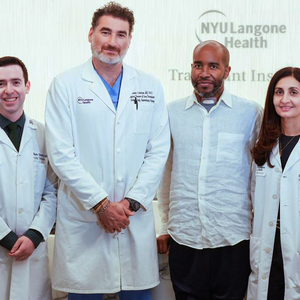
Decades-long effort of HIV-positive transplantation surgery achieves landmark first lung transplant
In June 2026, a team of surgeons at NYU Langone transplanted lungs from an HIV-positive donor into an HIV-positive recipient. The procedure, performed on patient Bertrand Nelson alongside a liver transplant, marked the final major milestone in a movement that began with a 1988 federal law that had made it illegal to use organs from HIV-positive donors at all.
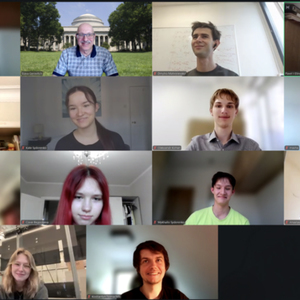
Yulia’s Dream: A better future for Ukrainian math
Professor Pavel Etingof and Dr. Slava Gerovitch co-founded the Yulia’s Dream program to support young Ukrainian mathematicians after Russia’s full-scale invasion of Ukraine. Four years later, it’s still running — and offering a glimpse into the dedication it takes to carry an intellectual community through a war-torn present.
Dr. Fauci among medical professionals presenting at the American Lung Cancer Screening Initiative’s third annual summit
The summit was organized to expand the diverse community of health care professionals and aspiring health care providers joining the fight against the most common cause of cancer death in the United States.
Expanding geothermal to all: Geo@MIT holds its first annual spring showcase
Geo@MIT holds the first annual Geo@MIT Spring Showcase, inviting industry experts and undergraduates to share their contributions to work done on decarbonization.
Meteor causes sonic boom over East Boston
Many New Englanders were startled by a meteor breaking the sound barrier on May 30, likening the noise to an explosion over their heads.
Does everyone research women’s health?
The inaugural Emerging Researchers in Women’s Health Symposium showcases the diversity of women’s health research and the researchers themselves to drive change in a historically overlooked field.
Richard Sutton talks vision for superintelligence in Dertouzos Lecture on May 13
On May 13, a packed Kirsch Auditorium welcomed 2024 Turing Award winner and “father of reinforcement learning” Prof. Richard Sutton for the Dertouzos Distinguished Lecture.
Residents of predominantly Black and Latino neighborhoods are about four times more likely to get hit by a car while walking or biking in Boston
A study from Boston Emergency Medical Services and MIT Urban Studies and Planning is the first to break down traffic accident risk by race, and the results are harrowing.
Zachary Abel on finding the factorial of 1/2
On April 28, the Undergraduate Math Association (UMA) invited Zachary Abel PhD ’16 to speak as part of the UMA Lecture Series.
From cell biology to tessellations
Raymond Goldstein blurs the line between mathematics and biology in the 2026 Simons Lectures.
The Marble Center celebrates its 10th anniversary, showcases success stories behind translating experiments to clinical products
Founded in 2016, the Marble Center for Cancer Nanomedicine is a collective of faculty research labs that aims to advance cancer nanomedicine, a field that seeks to detect, treat, and monitor cancer progression through biomaterials only a few water molecules in size.
From MIT to Veritasium
Leah “Sulli” Yost ’22 uses her MIT education to make videos for one of the world’s leading science YouTube channels.
A brighter future for the people of Africa: MIT Africa Innovate Conference pushes new plans for uplifting the African continent
Students and industry leaders from across the African diaspora came to MIT for a day of evocative discussions and technology-inspired business proposals for the future of the African continent.
Sleeping cancer cells hijack the wound healing pathway to wake up
New research shows that the awakening of disseminated cancer cells is caused by inflammation in the tissue microenvironment.
MIT animal rights group draws attention, but students question its impact
The people behind the “try our dog cookie” signs have a message, but is it getting through?
Research raises concerns about the effects of weight loss drugs on bone density
With campaigns featuring Serena Williams appearing across cities like Boston, experts warn the consequences may extend beyond weight loss to long-term health and body image pressures.
Women’s and Gender Studies researchers work to hold AI accountable
From healthcare to government, machine learning models are changing how decisions are made. This is what can go wrong.