Chocoholics Unite!
At the MIT Laboratory for Chocolate Science, eating experimental results is not just encouraged — it’s part of the fun






Veronika Moroz–The Tech
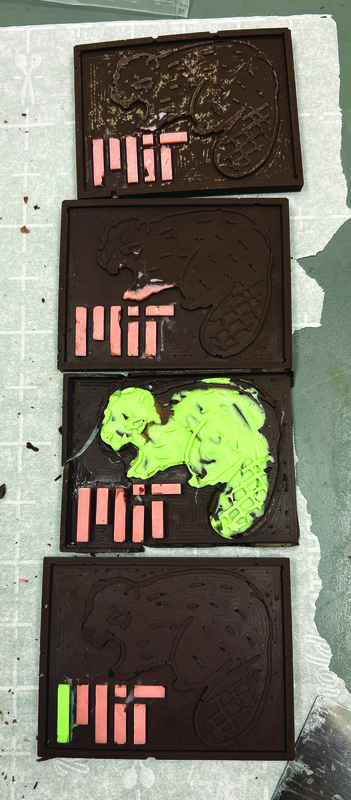
Image provided by MIT LCS
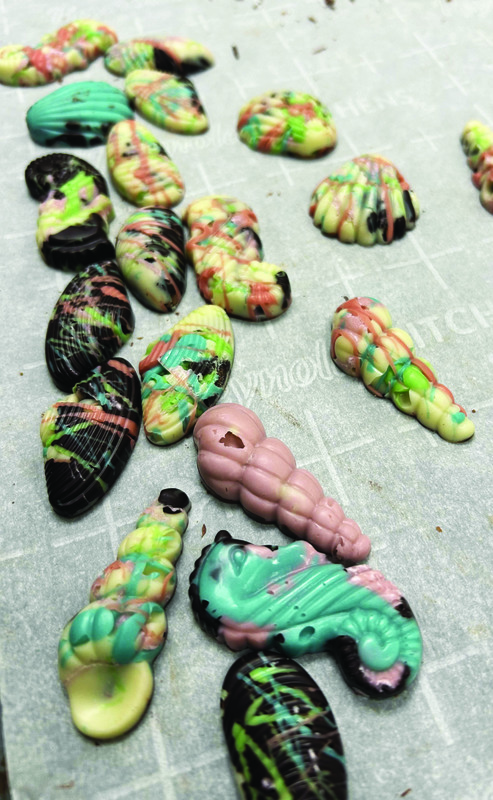
Image provided by MIT LCS
It’s Friday night, and a loud clanging noise can be heard from the ground floor of Simmons Hall. A group of MIT students and affiliates is hard at work performing a monumental experiment. The clanging is coming from the final step of their process, when they “set” their experimental creation by tapping trays against a table to pop any air bubbles that might complicate their results.
Not that those results could ever be anything less than delicious. The scientists in question are part of the MIT Laboratory for Chocolate Science (MIT LCS), a student group whose mission statement includes “spreading the appreciation of chocolate on campus.” Every Friday night at 7 p.m., members congregate at Simmons to make, discuss, and eat their favorite delicacy.
A sweet revival
The MIT LCS was founded in 2003. At one point, the club went through over 500 pounds of chocolate a year. For Sara Winther ’27, the club was one reason she chose to attend MIT. “I was like, ‘Oh, they have a chocolate club?’” Winther recalled. “‘This has to be a good place.’”
MIT LCS was on hiatus when Winther arrived on campus in 2023. That all changed at the end of her freshmen year, when Winther saw an email from past members looking for people to restart the club.
Winther immediately knew she had to join. “I was actually in Greece that specific day because I was on vacation with my family,” she explained. “We had just arrived. It [was] very late in the evening because of the time difference, and I [remembered], ‘Wait, I need to go on a meeting for chocolate. This is important.’”
Ever since that fateful meeting, Winther has served as the secretary of MIT LCS. A materials science student and avid chocolate expert, Winther sat down with The Tech to talk about the science behind this beloved Valentine’s Day staple.
The perfect bite
Chocolate comes from cocoa beans that go through a long series of processing steps. The beans are harvested, fermented, dried, shelled, and then ground up and mixed with other materials (like sugar or milk powder) and refined. The resulting intermediate — baking chocolate — is where MIT LCS’s molding process begins.
The club buys baking chocolate in bulk online, often from brands like Guittard and Calbot, before melting the chocolate to get their preferred texture. Chocolate is a complex molecule: while substances like water only have three phases — solid, liquid, and gas — chocolate has six. Each phase additionally has a different texture and melting point, corresponding to a specific crystal configuration of the triglycerides — the fats in cocoa butter.
The phases are numbered in order of melting point, with Phase I having the lowest and Phase VI having the highest. According to Winther, most chocolate eaters prefer Phase V, which “melts at about the temperature that you have in your mouth, but not the one that your skin is at.” Phase V chocolate also has an appealing glossy exterior and a “nice snap” when you bite into it, Winther said.
However, achieving the desired texture is not as simple as ordering a particular phase of chocolate online. To purify chocolate so that all of the crystals are aligned in Phase V, the MIT Chocolate Lab uses a process called tempering.
The science behind a silky-smooth bar
Tempering isn’t actually unique to chocolate: in fact, Winther noted that steel manufacturers use a similar process to produce strong iron. Here’s how it works: first, students heat up the chocolate, breaking all of the crystal bonds and liquifying the substance. When it cools down, the chocolate is mostly in Phases III, IV, and V. These are the highest available energy states because Phase VI takes a long time to form naturally.
To get rid of Phases III and IV, students raise the temperature between the melting point of Phase IV and Phase V. While not high enough to melt Phase V chocolate, the temperature is hot enough to melt all Phase III and IV chocolate in the mixture. As the former Phase III or IV chocolate cools, the crystals attach themselves in the Phase V configuration, Winther explained. This creates a bar with uniform texture.
Based on the size of the batch, MIT LCS can employ a special technique called seed tempering. By melting some untempered chocolate and then adding in about a third of its weight in tempered Phase V chocolate, this effectively creates a template for which crystal structure the cooling mixture should follow. MIT LCS has its own seed tempering machine, which they use whenever they’re working with at least 12 pounds of chocolate.
Once the chocolate has been tempered, the students pour it into special molds and tap the molds against the tables to release air bubbles. These molds are so delicate that they can only be hand-washed with warm water: any soap or corrosive chemical risks leaving a tiny hole in the mold where chocolate can get stuck. Excess cracks or moisture can disrupt the chocolate’s crystal structure, causing sugar or fat to crystallize on the outside of the chocolate bar and producing white stains called “blooms.” While sugar or fat blooms don’t change the taste or texture of the chocolate, they prevent the resulting candy from having the perfect sheen that confectioners desire.
Spreading love like it’s (melted) chocolate
MIT LCS’s meetings are open to everyone in the MIT community. Sometimes, they run chocolate molding sessions. Other times, they play board games and sample different types of chocolate, discussing the difference in mouthfeel and flavor profiles of beans from different parts of the world.
They also organize public-facing events, like tours of the Taza Chocolate Factory and fundraisers where they sell their creations. Last year, the club led a chocolate-making workshop at Walker Memorial for graduate students living at 70 Ames Street.
For Winther, MIT LCS has become more than just a place to celebrate chocolate. “It’s a community where I can actually relax,” she said.
By hosting meetings on Fridays, the club offers a space for people to de-stress after a long week. “Instead of just going home and collapsing and being like, ‘Oh my god, I have so much to do this weekend,’ you actually have a dedicated hour to hang out with friends,” Winther said. “And then maybe [you can] cheer up a bit, because [you] can get a bit of chocolate.”