Katie Spivakovsky ’26 named 2026 Churchill Scholar
Spivakovsky: “Really take advantage of all that MIT has to offer”





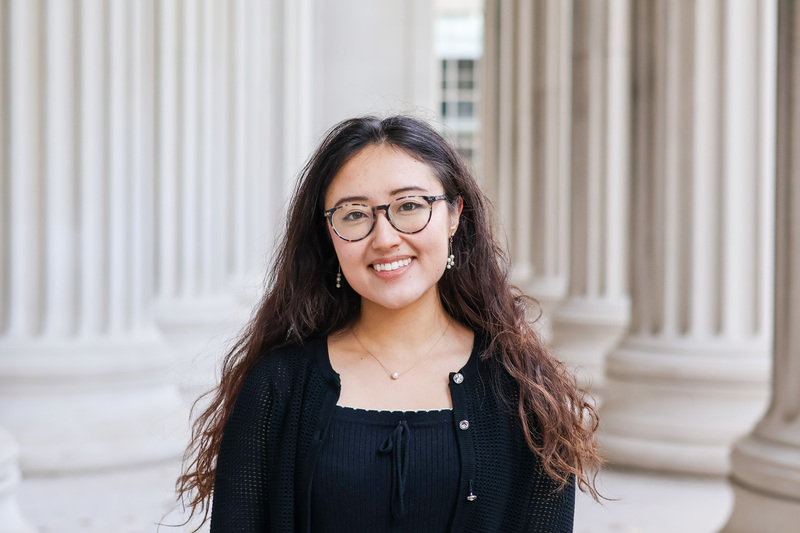
Photo courtesy of Hannah Wang
Katie Spivakovsky ’26, a biological engineering (Course 20) and artificial intelligence and decision making (Course 6-4) double major, was recently named a 2026 Churchill Scholar. Each year, the Churchill Scholarship provides 16 American students the opportunity to pursue a fully funded one-year master’s degree in science or engineering at the University of Cambridge.
At Cambridge, Spivakovsky plans to pursue a Masters of Philosophy (MPhil) in biological sciences at the Wellcome Sanger Institute, a genomics and genetics research institute. In an interview with The Tech, Spivakovsky reflected on her path to being named a Churchill Scholar. She spoke about her interests in leveraging experimental and computational techniques for gene editing and synthetic biology research.
This interview has been edited for length and clarity.
The Tech: What made you interested in applying for the Churchill Scholarship? How did you feel when you were selected?
Spivakovsky: I had a desire to take a year between graduating and starting my PhD, because I felt like [while] undergrad had taught me a lot, there were still some key skills in both molecular biology and computational modeling that I thought I’d benefit from before embarking on a PhD. For a while, I was considering doing the Course 6 MEng program here.
But in parallel, I also thought it made sense to apply for the Churchill as a way to gain direct genomics [skills] — in both wet lab and dry lab — at the Sanger Institute. It’s just a year to be at one of the best genomics institutes to gain some skills before starting a PhD.
When I found out, it was very shocking and surreal. I was doing a crossword with my boyfriend in my dorm, and an email notification popped up in the corner saying, “You’ve been selected.” I was so stunned that the notification went away, and I kept doing the crossword, until a few seconds later, it hit that this [was] actually something that was important. I was like, “Oh my gosh, I need to stop.” I called my parents, and I think the biggest thing for me was feeling like I had made them proud.
TT: What do you intend to do as a Churchill Scholar, and how does this connect with your long-term professional goals?
Spivakovsky: The Churchill year is just a single year, which is quite short. I’m going to be joining a project that a PI already has going on at his lab. I’ll be working on some of the gene editing tools that I haven’t had a chance to learn yet, like CRISPR-based tools and going into the wet lab and actually using them. But then [in] parallel, I’ll also learn some of the computational workflows that are associated with both analyzing that data and generating hypotheses to go back into the wet lab to validate. For my long-term goals, I do want to pursue a PhD after the Churchill year.
In my PhD, I want it to be pretty hybrid, like wet lab [and] dry lab. Ideally, I’m interested in synthetic biology for therapeutics and using machine learning and AI to inform the designs, but primarily developing therapeutic circuits for human health.
TT: How has your MIT experience shaped the person you are today?
Spivakovsky: MIT has been so formative for me. In a variety of ways, I feel like I’ve tried to do MIT to the fullest extent possible. I’ve double majored in Course 20 and Course 6-4 intentionally, and MIT has done a great job of helping me learn both of those spheres.
Beyond just the academics, MIT has offered a lot of amazing extracurriculars and research opportunities that have helped me really iron out exactly what I’m interested in. I’ve done multiple UROPs. I've been involved in clubs on campus, especially the MIT Biotech Group and the NEET (New Engineering Education Transformation) community, who are so inspiring and fun to be around as well as [giving me a] better glimpse into what kinds of topics I’m interested in.
MIT, philosophically, has taught me to embrace chaos and to really enjoy the feeling of biting off almost more than I can chew — but figuring it out as I go — and understanding how to tackle all of the fun opportunities in front of me.
That’s how I want to live my academic life: an intentional and fun chaos where I’m in the wet lab in the morning, scrambling to write code in between meetings, and teaching a class in the afternoon – just enjoying all of these different dimensions of life.
TT: What advice do you have for MIT students interested in fellowships like Churchill?
Spivakovsky: It’s easy to look at people who have won these [fellowships], see the stories that they portray and feel like it is such a polished package — that they must have been very intentional about how they crafted their story along the way. But I don’t think that’s true.
The best thing you can do for yourself is truly follow the things that you’re passionate about as an undergrad and trust that when it comes time for like applying either to PhD programs or to fellowships, if you just give yourself time to do some introspection, all of your past experiences will fall into place.
Besides that, really take advantage of all that MIT has to offer. I think faculty are amazing, especially in Biological Engineering. The clubs that I’m involved with have really incredible people that have taught me many different perspectives on life and academics. All of the research experiences and all these opportunities at MIT — just dive into everything.