MIT’s 7th annual quantum hackathon, iQuHACK, nurtures a new generation of quantum enthusiasts
1,400+ participants attended iQuHACK 2026, sponsored by NVIDIA, IonQ, and other quantum computing companies





Malakhi Beyah–The Tech
Jojo Placides–The Tech
The frigid air of Hayden Library, the enticing aroma of cheese pizza, and above all else, the commotion of cracking Hamiltonian equations: by hour 24 of iQuHACK, MIT’s annual quantum hackathon, participants could practically dream in quantum circuits as they sat in a superposition between sleep and deep concentration. With only three days to compete, the teams spent every free second huddled in an entanglement of laptops and research papers, searching for the best solution to their chosen challenges.
iQuHACK ran from Jan. 30 to Feb. 1, with more than 400 students from U.S. universities participating in person and 1,000 students from 76 countries joining virtually. This year, the event was sponsored by 15 major quantum technology companies: NVIDIA, IonQ, IQM, QuEra, Superquantum, Alice & Bob, Quantum Rings, Nord Quantique, qBraid, BlueQuibit, Classiq, and Quantum Design.
At the heart of the event was the field of quantum computing. While a classical computer uses bits, which process information as 0s or 1s, quantum computers use qubits, which represent 0, 1, or a state between both — a state of “superposition.” This property allows a quantum computer to solve problems that classical computers cannot, such as molecular simulations, optimization, and cryptography.
However, the field of quantum computing has seen no practical uses so far, as quantum systems are too unstable to be manufactured and shipped out to the public. Small changes and disruptions in the environment are enough to destabilize qubits, leading to high error rates.
Nevertheless, fault-tolerant quantum computers, which are computers that can resist these disruptions in the environment, are seemingly “only 10–15 years away,” according to QMIT Faculty Director and Professor of Chemistry Danna Freedman PD ’12, one of iQuHACK’s keynote speakers.
MIT launched iQuHACK in January 2020 as quantum computing began growing in popularity. “The goal of iQuHACK has always been to give undergraduate students the opportunity to learn about the near-term challenges and applications of quantum computing hardware,” explained iQuHACK Director Om Joshi G.
Competitors choose challenges designed by iQuHACK sponsors
In order to have a quantum computing hackathon, people need access to quantum computers or simulations of quantum computers. During iQuHACK, teams were able to utilize quantum hardware or GPUs to simulate quantum hardware using platforms such as qBraid and Brev. This allowed them to solve problems that required quantum computing solutions.
On the first day of the competition, each event sponsor revealed their company’s specific challenge, and each team chose one to tackle. Mentors from the sponsor companies provided guidance and feedback to these teams and acted as their judges at the end of the competition.
Students who chose NVIDIA’s challenge were given a problem known as the Low Autocorrelation of Binary Sequences (LABS) problem, a demanding optimization problem that has applications in radar and telecommunications technologies. In this challenge, teams were told to mimic a real-world research and development (R&D) pipeline, with each student in the team taking one of four roles: project lead, graphics processing unit (GPU) acceleration person-in-charge (PIC), quality assurance PIC, and technical marketing PIC. The first phase of the project was the research and development phase, where students used qBraid to simulate and design quantum systems. Then, the solutions they came up with were scaled up to more powerful hardware using Brev.
IonQ took a more lighthearted approach to their quantum challenge, tasking teams with beating their “entanglement distillation game.” The game is played on a graph representing a quantum network; the vertices represent quantum computers that host “utility qubits” (or points) and bonus resources, and the edges represent entanglement links that connect two nodes. The objective of the game is to maximize the amount of utility qubits while managing a limited budget of entanglement links.
Challenges from other sponsors included analyzing the performance of OpenQASM 2.0 quantum circuits, exploring how quantum methods calculate financial risk, and modeling noise and parallelism in quantum error correction circuits.
Students take on quantum challenges
Amidst the buzzing backdrop of the Student Center, The Tech interviewed competing iQuHACK teams as they diligently worked toward solutions to their quantum computing challenges.
For Felix Antoine, a second-year undergraduate student from the University of École de Technologie Supérieure in Montreal, Canada, iQuHACK marked his first time competing in a hackathon.
His team’s challenge involved replicating a particular quantum state presented to them the day before; however, he admitted that he would likely be relying on his more experienced teammates. “I haven’t even done any classes on quantum computing, which is why I’m kind of struggling right now with this challenge,” he said. “It’s very exciting; I’m learning so much stuff in only a couple of hours.”
Other groups competing at iQuHACK had a considerable amount of experience in the field. The four PhD students and senior undergraduate comprising a team from Clemson University had all already competed in multiple quantum hackathons; Abrar Faiyaz, one of the PhD students, had even won one of the iQuHACK challenges in 2025.
The Clemson team was focused on completing Superquantum’s challenge. Their work involved improving a quantum computer’s compiler, a software that breaks quantum programs into instructions the machine can understand. “Certain instructions are more expensive than others, and there’s multiple ways to break it down,” Faiyaz explained. “So the challenge today is about breaking a program into [more] cheaper instructions and fewer of the expensive ones.”
Faiyaz, alongside teammates Nathan Jones, Landon Holcomb, John Layton, and Valentine Mohaugen, would later win the first-place prize for Superquantum’s challenge.
For some competing students, the end goal wasn’t to take home a prize. Aanya Bhandari, a senior undergraduate studying computer science and quantitative finance at the University of Florida, reflected on what brought her to iQuHACK.
“I actually didn’t go into this with a prospect of winning at all,” she admitted. “I think, for me, it was more about learning something new because quantum is such a relative[ly small] field that it’s hard for computer scientists without a physics background to get into.”
Bhandari’s team was tasked with implementing quantum error correction as part of QuEra’s challenge. The fundamental question behind this challenge was how to accurately read the “gray” area between qubits’ 0 and 1 states.
“So if we’re expecting it to be 0 and it’s becoming 1s,” Bhandari explained, “how can we stop it as we detect that it’s about to be 1 and then shift them back?” This seemingly simple question was the reason she only got an hour of sleep that night.
Regardless of their prior experience with the quantum field, participants agreed that competing at iQuHACK was exhilarating.
The Clemson team, even having competed in other hackathons in the past, remarked that there was something particularly special about iQuHACK. “I like the city, I like the campus,” Layton said, “and I like being surrounded by a lot of intelligent people who have a lot of good ideas and are working towards the same goal.”
Antoine echoed that sentiment, especially from the viewpoint of an international competitor. “I heard that it was the biggest quantum computing hackathon of the year,” he recalled. “It’s also the opportunity. I’ve never been to Boston, [...] so I was like, ‘Yeah, I’ll go to see MIT!’”
Announcing the final results of iQuHACK
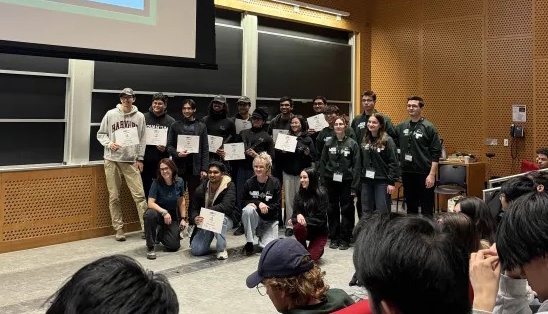
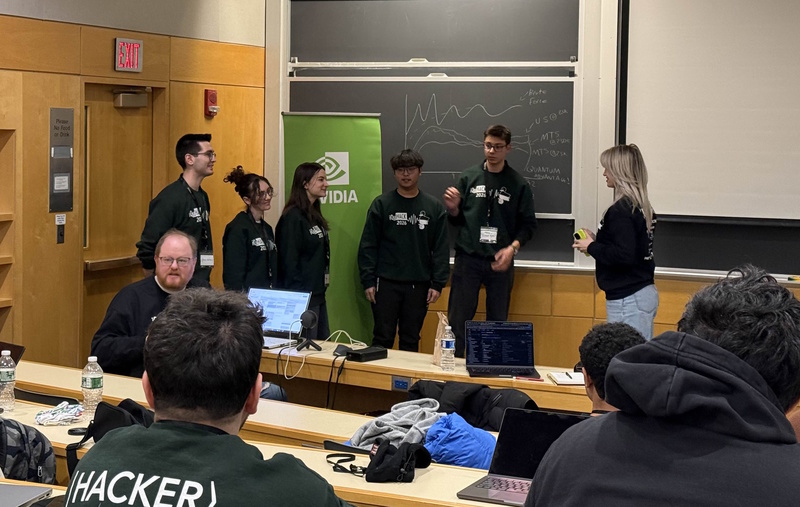
On Feb. 1, each team was given ten minutes to present their findings in front of a panel of mentors from the sponsor companies. After an intense hour of waiting for the results — the fruits of their 72 hours of toil — competitors flocked to the Stata Center to hear the winners of each sponsor’s challenge. The sponsors gave out various prizes, ranging from Amazon gift cards and Nintendo Switches to merchandise and Brev credits, which are units of currency for buying computation.
The Tech interviewed Jack Ploof, a first-year Harvard undergraduate and member of team Piqasso, which came first in QuEra’s challenge.
Ploof’s team compared two properties of quantum circuits: the “fidelity” and the “magicness.” In quantum computing, fidelity is the measure of the difference between observed, physical data and expected, theoretical data. On the other hand, “magicness” measures the difference between an arbitrary quantum state (any possible quantum state) and a “magic” quantum state, a special quantum state needed to achieve fault-tolerant quantum computation.
“We actually found no correlation between this “magicness” value and the fidelity, which was a pretty interesting result,” said Ploof.
Though Ploof considered himself lacking a rigorous background in quantum mechanics, he became interested in tackling quantum computing after participating in MIT’s Quantum Winter School over IAP as well as examining the research of Norman Yao, a physics professor at Harvard University.
In the IonQ challenge, the team led by Allen Wu ’29, iQuackers, won second place. Their project focuses on a way to filter noise from quantum networks. Most of the time, noise — uncontrollable disruptions from the environment, whether from magnetic or thermal sources — can disrupt quantum environments, leading them to have high error rates. Therefore, Wu’s team designed ways to clean up their data using adaptive protocol selection: in other words, combining different existing protocols for dealing with the noise. “In the real world, it’s quite probable that the source of noise is unknown,” Wu said, “so hopefully there’ll be ways to more dynamically test and swap protocols in real-time.”
Though his team encountered small issues along the way, in Wu’s words, “that’s always fun to figure out with a team.”
Developing the future quantum workforce
For keynote speaker Pedro Lopes, a quantum scientist and lead educator at QuEra, iQuHACK is among the most important events in quantum computing for developing the field’s upcoming workforce.
As a mentor for the event, what stood out to Lopes the most was the number of young people with no prior experience in quantum computing tackling QuEra’s challenge. “It takes a lot; you have to read papers. You have to kind of extrapolate from our codebase and grasp a bunch of concepts that you’re really starting from zero,” said Lopes.
Lopes cited the intensity of the event as one crucial factor to how it kickstarts quantum careers. “iQuHACK is the crucible, a place that is hot and has high pressure, [where] people are fighting against themselves and fighting against the fact that they are trying to take a step bigger than their legs,” he said.
The number of students competing in iQuHACK has grown over the past few years. This year’s hackathon also saw the highest number of challenges and sponsors that the event has ever had, with the participation of major quantum companies like NVIDIA and State Street, as well as new ones like Superquantum and Quantum Design.
In her keynote speech, Freedman highlighted the importance of these young researchers, stating that, as they get exposed to the relatively fresh field, “[they] all get to acquire [their] own opinions” selecting quantum-driven solutions to these long-standing problems.
“We need to bring together teams that can leverage their deep expertise to build networks to bring everyone together,” Freedman said.
From the challenges to the collaboration to the endless boxes of cheese pizza, iQuHACK continues to be a launchpad for future quantum scientists and engineers, providing the energy and community to do just that.