MIT to “monitor” the release of Epstein files before probe decision, President Kornbluth says
Kornbluth: “I’m really troubled by what we’re learning, but it’s premature to say how we’re going to proceed”





Lee Chen–The Tech
Lee Chen–The Tech
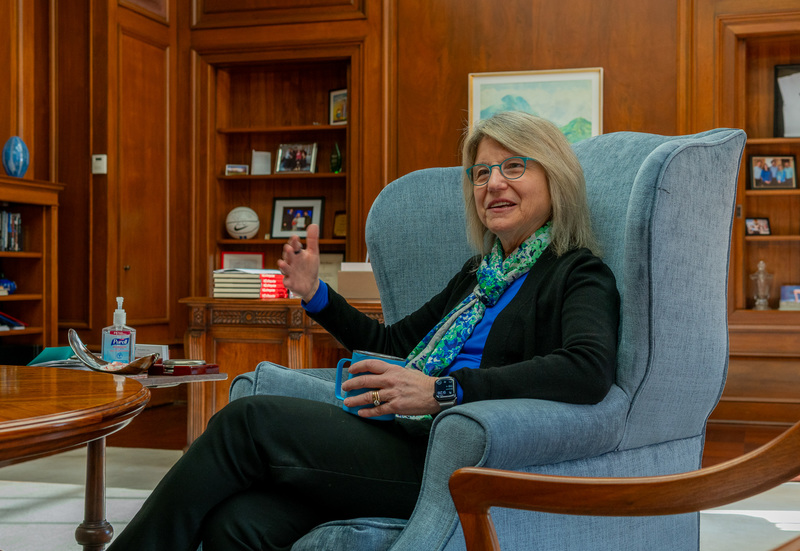
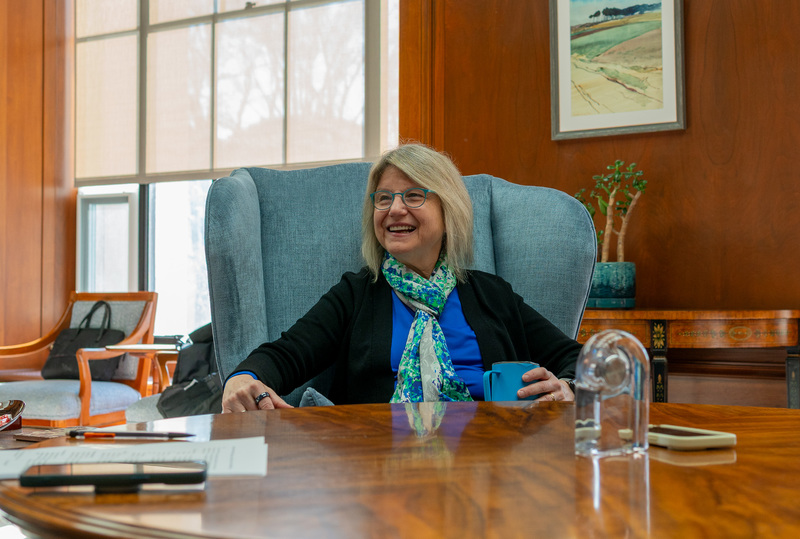
“All of these revelations make us recoil,” MIT President Sally Kornbluth stated in an interview with The Tech on Feb. 11 regarding Epstein’s ties with current and former MIT affiliates. “But it’s premature to say how we’re going to proceed,” she added.
“This is a really fast moving train,” Kornbluth said, pointing to the roughly three million pages of Epstein documents released by the U.S. Department of Justice on Jan. 30, 2026.
According to Kornbluth, Institute administration is not currently running an internal investigation into the new files; rather, they are just “waiting and seeing.” She also mentioned that MIT was not actively “looking for incidents,” citing how there are “people everywhere mining” the files.
When asked if MIT was going to release an official statement about the situation, Kornbluth said that she would not like to say something preeminently and have to “change course” a few days later due to the rapid pace of new updates.
On the Goodwin Procter report
This is not the first time the Institute has faced public scrutiny regarding the ties between certain faculty members and Epstein. Under former President L. Rafael Reif in 2020, the law firm Goodwin Procter was hired to investigate the ties between the convicted sex offender and MIT, culminating in a 61-page report.
Kornbluth asserted MIT’s record of “paying close attention” and “thinking carefully,” lauding the Goodwin Procter report for being “thorough” and exceeding other “such investigations in many other sectors of society.”
Many of the same names in the 2020 report, including current professors Seth Lloyd, Neil Gershenfeld, and Ed Boyden, appear again in the latest trove of files. However, these new documents paint a far more vivid picture on the nature of these relationships.
For instance, in one newly released email uncovered by The Tech, Professor Gershenfeld suggested to Epstein that their meeting would be a “warm-up” for “more entertaining venues”; in another, Professor Boyden accepted an offer to visit Epstein’s New Mexico ranch along with Harvard Professor Martin Nowak, which was not explicitly disclosed previously.
Meanwhile, the ramifications of the new trove of files are already being felt at peer institutions.
Down Massachusetts Avenue, Harvard has recently expanded its Epstein probe, and, in November 2025, former Harvard University President and professor Larry Summers ’75 took a leave of absence from his teaching role due to new revelations regarding his long-term relationship with Epstein even after the sex trafficker’s 2008 conviction. At Yale, computer science professor David Gelernter was suspended from teaching after troubling emails with Epstein surfaced, including one describing an undergraduate as a “v small goodlooking blonde.”
At this time, it is unclear if MIT will take action as well, as Kornbluth refused to comment on individual cases during the interview.
On vetting sponsor money
In the wake of the Epstein findings, Kornbluth gave The Tech an overview of new procedures implemented to vet sponsor money following the 2020 report. She mentioned “vetting at multiple levels,” including with senior leadership overview and a gift acceptance committee. “People always portray universities and university presidents as seeking the money,” she said, but “we really want to be on the right side ethically.”
According to Kornbluth, MIT has turned down “significant” gifts where the individual or circumstances have been “troubling.” She acknowledged situations where MIT would have to renege on a gift after troubling details emerged, stating they would not “hesitate” to return money or “to bring it to light.”
“The most important thing… right now is transparency,” she added.
In early June of last year, however, MIT discontinued the Brown Book, a supplemental publication listing the fiscal contributions of primary and direct research sponsors. According to MIT spokesperson Kimberly Allen, doing so brought “MIT’s finance reports in line with typical practice while remaining fully compliant with federal requirements.”
Referring to the Epstein funding incidents, Kornbluth noted them as a very significant event in the history of the Institute. “None of us want to be there again,” she said.
The Tech also asked about the Institute’s general position on navigating public scrutiny regarding funding from controversial sources. “I want to be transparent, but I also don’t want to rely on others to tell us what the right thing and the wrong thing to do is,” Kornbluth said.
Pointing to an “ever-changing” political landscape around fundraising, especially international fundraising, Kornbluth noted that MIT has to “interact with other entities in ways that we think are morally right and satisfactory.”
“We’re not doing quid pro quos in terms of donations; we believe that when people give MIT money to do the work, it’s to do our best and highest work, and we just have to assess whether the constraints and the source will allow us to do that,” she said.
Referring broadly to Epstein’s involvement with MIT research groups, Kornbluth noted it was “just one example of something that can go wrong,” adding that the way to proceed is not to “scrutinize” every research group but to think about “what responsible conduct of research means overall.” She explicitly mentioned how MIT Vice President for Research Ian Waitz is “rethinking that [and] putting in new educational modules.”
On immigration and international students
On Dec. 1, 2025, President Trump sent U.S. Immigration and Customs Enforcement (ICE) troops into Minnesota after weeks of criticizing the state’s significant Somali population following reports of a fraud scandal. Doing so sparked protests across Minnesota, with heavy ICE crackdown on demonstrators in response.
Later, on Jan. 7, a video of the killing of Renee Good, a 37-year-old U.S. citizen, served to spark nationwide outrage, including in Boston, which has seen several anti-ICE protests within the last few months. When asked about a hypothetical scenario involving ICE appearing on campus or individuals being “hounded,” Kornbluth said that it would “very likely elicit some strong response” from MIT.
Kornbluth added that she was “horrified” as a “human being” about what is happening in the country right now in relation to how some of these people were being treated, stating that, “I don’t care whether they’re from other countries, the ‘American First’ thing doesn’t resonate with how you treat people.”
On the subject of international students at MIT, Kornbluth praised them as “the lifeblood” of the science and engineering that takes place at the Institute. “It’s an incredibly important value to me to protect these students,” she said. “What that looks like? I don’t know.”
“What I can say is, regardless of what your positions are on a variety of issues, the best thing to do is to call the MIT Police. Our police do not give out information on our students. They’re not going to let people into places where they're not supposed to go without warrants,” Kornbluth said. “If there’s any problem with students, we’ve already arranged so that they can get pro bono legal advice, etc.,” she added.
On the TFUAP’s future plans for undergraduate education
The Tech also asked Kornbluth to share some words for students expressing their opinions at the TFUAP town hall on Feb. 23. The 85-page proposal listed numerous changes to undergraduate education at MIT. “I would have a rational, educational or lifestyle reason for the answers,” she said. “I would come in expecting respectful dialogue.”
“This is not just performative. [Faculty and administrators] want to hear what folks have to say,” she urged.
“These changes are not dramatic. It’s not like we threw out the whole system, but they’re targeted to things that we really know that students need,” Kornbluth said, mentioning how she has “repeatedly” heard employers express concerns that students are not prepared to work as a team, especially considering that “some members of that team in the future may be AI.”
Kornbluth acknowledged the arguments about moving the add/drop dates earlier and removing double booking. “But one thing I learned as the provost at Duke, and I know now as president: the curriculum belongs to the faculty,” she said. “[The curriculum] should be a conversation between the faculty and the students.”
A correction was issued on Feb. 19, 2026: A previous version of this article stated that Larry Summers resigned from his teaching position at Harvard. Summers actually took a leave of absence.