Mariam Abdelbarr, Francesca Garfi elected 2026–2027 UA President and Vice President
This year’s election was significantly more contested than usual





Grace Zhang–The Tech
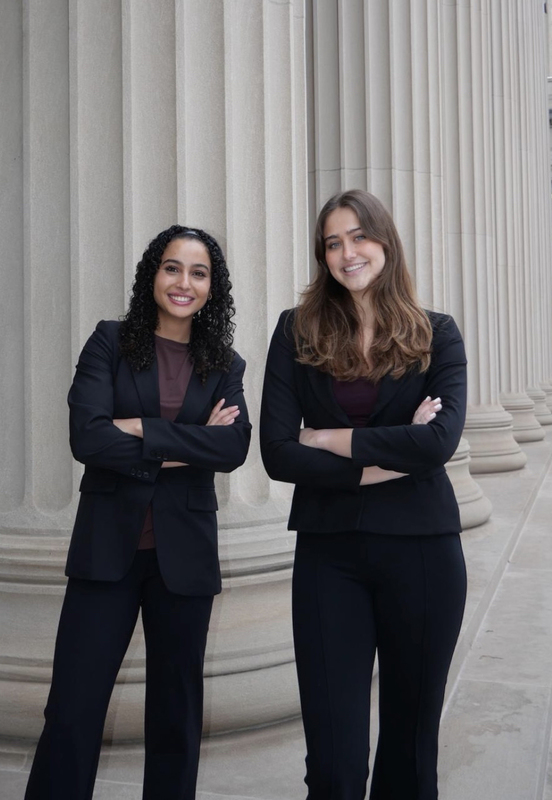
Photo courtesy of Fernanda Guerrero
On Sunday, March 22, at 6:15 p.m., the Undergraduate Association (UA) Election Commission announced that Mariam Abdelbarr ’27 and Francesca Garfi ’29 will serve as the 2026–2027 UA President and Vice President, respectively.
In the email, the Election Commission also released the full election results. 1,688 undergraduates voted, comprising 37.2% of the total undergraduate population — an increase from the previous year’s 30.0%. Students also voted for class council representatives for the Classes of 2027, 2028, 2029.
In the presidential and vice presidential election, Abdelbarr and Garfi were the first choice on 790 ballots; in the final round of counting, they finished with 981 votes, which represents 58.1% of the total. Runners-up Rivka Lipkovitz ’29 and Anthony Donegan ’28 were the first choice preference on 547 ballots and received 636 votes overall. Finally, candidates Johnnie Jones VI ’27 and Matthew Barnett ’27 received 322 first-choice votes before being eliminated in the final round.
A distinctly controversial election
Due to heated discussion about student governance leading up to the election, this year’s UA Presidential and Vice Presidential election was significantly more contested than usual.
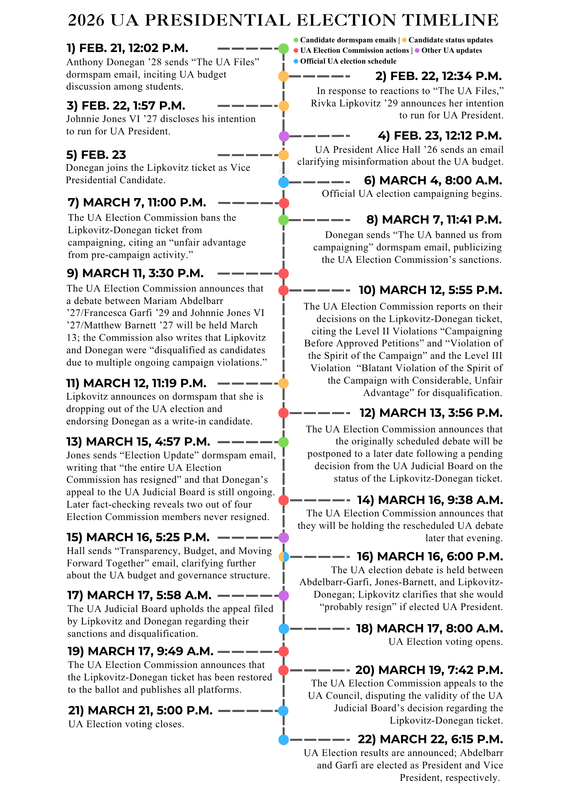
On Feb. 21, a dormspam email sent by Donegan — who was not yet a candidate — prompted numerous conversations about the size of the UA’s budget, its governance structure, and line item budgeting. In response, the UA sent out an official statement addressing points of conflict; UA President Alice Hall ’26 also sat down with The Tech to discuss these issues.
While Donegan stated he did not initially plan to run for office in his initial dormspam thread, he officially joined Lipkovitz’s ballot as her Vice Presidential candidate two days after the email, according to a report by the Election Commission.
From there, tensions between the Lipkovitz-Donegan ticket and the Election Commission persisted from the beginning of campaigning until polls closed. On March 7, three days after the official UA Election season had begun, the Election Commission sanctioned the Lipkovitz-Donegan ticket, preventing them from campaigning due to an “unfair advantage from pre-campaign activity.”
After Donegan publicized the initial sanction, the Election Commission escalated the penalty to disqualification on March 12, prompting widespread backlash. The Lipkovitz-Donegan ticket appealed the Election Commission’s decision to the UA Judicial Board, and the UA presidential debate, originally scheduled for March 13, was delayed pending a decision.
Ultimately, the Lipkovitz-Donegan ticket was allowed to participate in the rescheduled debate on March 16, and the Judicial Board upheld their appeal on March 17, just two hours before voting opened.
Candidate responses
In a statement to The Tech, Abdelbarr expressed enthusiasm about stepping into her new position despite the turbulent election season.
“We are so excited to step into this role, begin onboarding, and align in a way that brings about the student government students want to see,” Abdelbarr wrote. “We are also so grateful that more of the student body is interested in and engaged with what the UA is doing and what we plan to do in the future.”
Abdelbarr and Garfi ran on a platform of increased transparency, improved access to food, and ensuring the safety of all MIT community members, especially “international and marginalized students.” Abdelbarr also promised stability and concrete results, citing her prior experience as the 2025–2026 UA Vice President.
Despite the loss, Donegan remains firm in his resolve to effect change in the UA. He will continue serving as a UA Council voting member to “advocate for a more efficient and transparent student government.”
“My dormspam and campaign brought attention to the lack of transparency and fiscal responsibility in our student government. I believe my actions have already created positive and lasting change, and I am glad I had the opportunity to stand up for my beliefs,” Donegan stated.
Jones expressed reservations about whether the “fundamental issues” with the UA would be resolved with Abdelbarr’s presidency.
“Based on the lack of a clear list of priorities … and the commitment in her postering to many of the same policies that earned the UA a reputation for frivolous spending, I have my doubts,” Jones wrote. Moving forward, Jones plans to work with Abdelbarr to address important issues on campus.
Community responses
Former Election Commission member Ananth Venkatesh ‘28 called Abdelbarr and Garfi’s victory “well deserved.” However, he was “very disappointed” by the Election Commission’s decisions to remove the Lipkovitz-Donegan ticket from the ballot and appeal the UA Judicial Board decision.
Venkatesh also raised various concerns about the UA’s current election structure. According to him, signature requirements for candidates burden opposition candidates and “greatly favor” the incumbent, leading to many one-candidate elections. In addition, Venkatesh worries that the current voting system is vulnerable to spoilers and vote splitting effects.
He lauded the unique competitiveness of this year’s election, explaining how it pushed candidates’ platforms to “reflect an influx of new ideas from the student body and candidates around them.” Finally, Venkatesh looks forward to seeing the UA administration increase funding for student groups and participatory budgeting, as well as expand dining opinions and “other forms of direct democracy.”
Hall, the outgoing UA President, was happy to see increased engagement this election cycle, but criticized how “conversations went from productive to destructive.”
“Everyone at this school is special and has something unique to offer,” Hall wrote as parting advice to the MIT community. “Even if at first, it seems that you do not see eye to eye, be patient and try to understand one another because when we work as a team, we can do incredible things at MIT and beyond.”