The BLO’s ‘Das Lied von der Erde’: immense tragedy in slim form
A reimagined performance of Mahler’s symphony inaugurates the BLO’s new performance space





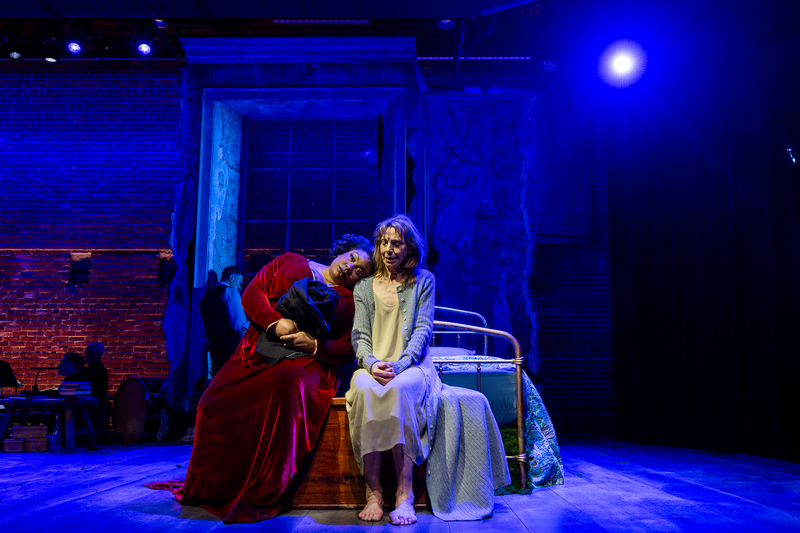
Photo courtesy of Nile Scott Studios
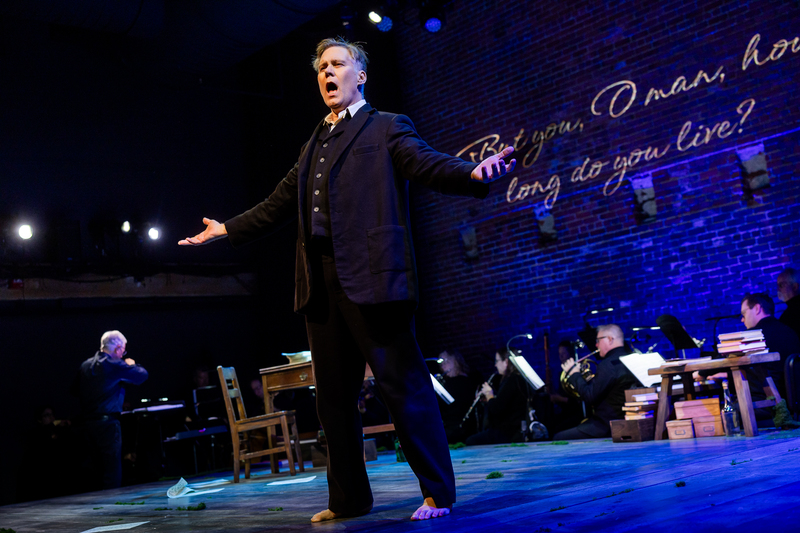
Photo courtesy of Nile Scott Studios
Gustav Mahler’s Das Lied von der Erde, arr. Arnold Schoenberg
Boston Lyric Opera
Conducted by David Angus
Opera + Community Studios
March 20–29, 2026
From March 20 to 29, the Boston Lyric Opera (BLO) delivered Gustav Mahler’s Das Lied von der Erde, or the Song of the Earth, in chamber arrangement by Arnold Schoenberg. This was no conventional performance of the Song of the Earth; the work has been reimagined to concentrate the themes of tragedy that have remained largely latent in other renditions.
This work inaugurates the BLO’s newly renovated Opera + Community Studios, a smaller and more intimate hall that seats just 250 concertgoers. Featuring exposed brick walls and visible circuitry, the theater has a certain millennial charm but still serves as an excellent performance space. In such a small hall, the audience enjoys the privilege of experiencing the actors up close with all their microexpressions and slight movements, though this intimacy sets a bound on the maximum size of the pit orchestra.
Mahler finished this composition in 1908, only three years before his death at the age of 50; it was never performed in his lifetime, premiering six months after his death. Along with his later works, the orchestral piece exists in the context of his personal tragedies of 1907, when he was forced to resign as director of the Vienna Court Opera, experienced his eldest daughter’s death from scarlet fever and diphtheria, and was diagnosed with a cardiac valvular defect that would later take his life. Yet the music itself speaks to both death and life. Though the outer movements deal directly with death (famously, the quote “dark is life, is death” repeats through the first movement, each time a semitone higher), the inner movements present visions of life, be it spent with friends, in reflection, or in drinking. Indeed, Mahler himself wrote in a letter in 1909, two years after his annus horribilis: “...I am thirstier for life, and I find the ‘habit of living’ sweeter than ever.”
The BLO brings out these themes by introducing three characters: the Poet (Brandon Jovanovich), the Lover (Raehann Bryce-Davis), and the Mother (Ellen Lauren). The Poet and the Lover both present singing parts, while the Mother presents various lightly-accompanied declamations at the start and between movements. Though the three inhabit the space of a single Victorian room, they never truly interact with one another; the synopsis suggests that the three “exist in different temporal states, their lives overlapping without fully touching.” In them, we see three different narrative arcs in response to grief. The mother, through immense difficulty, moves on. Meanwhile, the lover goes mad, and the poet, after drinking wildly, is implied to have committed suicide.
Story-wise, the Mother’s narrative arc is well-highlighted throughout the work as she copes with the loss of her daughter. In a sense, the Mother is the projection of Mahler, with the songs variously illustrating, complementing, taunting, or refuting her current psychological state. She begins totally shattered, able only to count individual seconds. But as the work progresses, she forces herself forward, day by day, until she is able to compromise with the grief within her and move on by the end, in one way or another. Lauren brings out her part beautifully; her skin is positively pallid in the work and hangs from its bony frame, each motion belabored by the grief her character carries. At times, these declamations can feel rather on the nose, referencing writers like Austen and Perkins Gilman and thinkers like Turner, Nietzsche, and Freud; nevertheless, they are delivered superbly, and only become more and more excellent as the story progresses. When not speaking, her acting goes along well with the songs of the others, illustrating her own path from darkness into grey light.
The two other actors get their own time in the spotlight as the songs unfold. Jovanovich is certainly able to hold his own; he is more than capable of executing the jumpy half-dances of “Von der Jugend” (Of Youth) while very convincingly acting the part of a drunkard in the opening and in “Der Trunkene im Frühling” (The Drunkard in Spring). Yet, the highlight by far was Bryce-Davis. Through the entire work, she was able to maintain character as the Lover. Her acting supports not only her own emotional narrative but also that of the other members of the cast. In particular, her microexpressions were very precise, bringing out grief and sorrow both exposed and hidden in songs like “Der Einsame im Herbst” (The Lonely One in Autumn) and “Von der Schönheit” (Of Beauty), respectively. And as the three stories reach their climax in the finale — “Der Abschied” (The Farewell) — she is able to hold together the disparate narrative threads, as she ascends to an almost narrator-like perspective and goes mad.
If there was anything wanting though, it most likely lay in the accompaniment. Without a doubt, David Angus as conductor and the entire chamber orchestra should be congratulated for their efforts; the winds were especially superb, bringing out their soli incredibly well and adding to the eeriness and liminality of the whole work. Certainly, the leaner movements such as “Von der Jugend” and “Von der Schönheit” gained an almost Ravelian or Boulezian quality, with Angus’s taut conducting bringing out the uncanny and clashing side of the music. However, the extremely spare strings (one to a part) and brass (a single horn in F) occasionally struggled; for example, the grand fanfare after the first declamation is produced by a single French horn, inadequately supported by the five strings. It is fortunate that the work lends itself well to such transparency; however, even a single extra string to a part might have hidden the occasional seam and further supported the excellent singing.
Overall, the BLO has successfully reimagined Das Lied von der Erde, making salient the more philosophical and emotional undertones that lie within the work. I look forward to future performances in the BLO’s Opera + Community Studios as an opportunity to bring out the more personal side of opera, with an opportunity for entirely new timbres and textures in service of further expression.