The search for eco-friendly energy: MITxGE Vernova alliance unveils novel climate-positive energy research
Five months after the announcement of a five-year partnership, MIT and GE Vernova come together to showcase the newest breakthroughs in renewable energy





Malakhi Beyah–The Tech
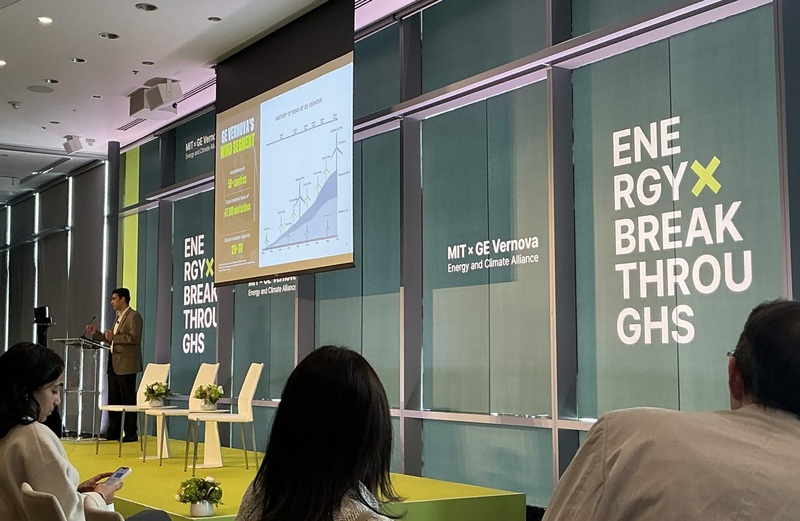
On Feb. 11, MIT hosted an inaugural symposium in collaboration with energy company GE Vernova at the Samberg Conference Center. Spotlighting the theme “Energy X Breakthroughs,” the symposium built upon the earlier MITxGE Vernova Energy Climate Alliance Launch on Sept. 15, 2025 to showcase the importance of collaboration in finding climate solutions through “Decarbonization, Electrification, Renewables Acceleration, and Digital Solutions.”
The alliance is largely rooted in the federal government’s continued restriction of universities’ research funding, compelling MIT to search elsewhere for a reliable sponsor. The Institute has recently found that sponsor in GE Vernova, a former branch of General Electric that specializes in “continuing to electrify to thrive and decarbonize the world,” according to the energy company’s website. Their official partnership was announced in the spring of 2025, with GE Vernova pledging a $50 million investment across five years to fund “research initiatives, student fellowships, internships, educational and professional development programs, and philanthropic projects” at MIT. GE Vernova CEO Scott Strazik and MIT Provost Anantha Chandrakasan are spearheading the initiative as co-chairs of a joint steering committee between the two institutions.
February’s symposium featured former Secretary of State John Kerry, who delivered the event’s opening remarks to a room of MIT students and faculty. In his address, Kerry explained how multi-institutional collaboration is necessary for progression toward a greener future.
“We simply can’t do it without the private sector’s expertise, experience, balance sheet, and global value chains,” Kerry said. “No government — and I can tell you this having worked for years [in the federal government] — no treaty, no NGO can deliver this transition alone.”
With that, the event launched into the many ways MIT and GE Vernova are delivering in the sector of renewable energy.
A turbine-driven future
Wind currently provides about 10% of the global energy demand. Getting that figure closer to 25% would put humanity in a better position to address the climate crisis, said Charudatta Mehendale, the mission director of GE Vernova’s wind innovation programs. However, the underlying physics behind the turbines’ function prevents engineers from simply making them larger to surpass the 25% goal.
Mehendale moderated a panel discussion with Civil and Environmental Engineering Professors Michael Howland and Tal Cohen.
“The power production of a wind turbine scales with the diameter squared,” Howland stated, “so there’s a huge incentive in the power and energy yield associated with these devices to [make] it larger.”
According to Howland, a single blade of an offshore wind turbine can stretch from the nose to the tail of a commercial airplane — twice. “These [larger] turbines are accessing larger and newer portions of the atmospheric wind flow that we understand less about,” he said.
The other major challenge concerns aeroelasticity, the interaction between aerodynamic forces and the flexibility of objects exposed to air flow. If those forces are not properly accounted for, blades could stall or fail, so a good grasp of aeroelasticity is essential, Howland explained.
Howland then addressed the question of how new turbine blade designs are tested. In an ideal world, blade designs would be tested at scale in a real environment; however, it is hard to complete a controlled experiment with this method.
“In that setting,” Howland explained, “the wind conditions in the atmosphere are constantly changing: wind direction, turbulence, wind speed, everything.”
Without knowing what specific atmospheric influences were impacting the blade’s behavior, it would be considerably difficult for engineers to know how to improve the blade’s design.
The alternative is testing blade designs in a laboratory setting. Researchers would create a scaled-down replica of a blade prototype (spanning only tens of centimeters across) and place it in a wind tunnel, allowing them to control particular aspects of wind flow around the blade. Though controlled experiments are more feasible, the physics changes with this design.
“You cannot match the Reynolds number [a dimensionless measure of turbulence] and other associated non-dimensional parameters that govern the physics of modern wind turbines in conventional wind tunnels,” Howland said.
Howland’s research aims to uncover how increasing the air pressure in wind tunnels (which normally operate at atmospheric pressure) can better simulate the conditions turbine blades will encounter in real environments.
Looking ahead of the testing phase, Cohen stated that the way turbine blades are currently produced and transported hinders the scale at which better designs can be implemented. She described the decades-old practice of making turbine blades, which involves large molds and thousands of hours of manual labor. Even when the blade is created, moving the football-field-sized structure can be difficult, Cohen said.
Cohen described how her research in polymerization may prove helpful in manufacturing the increasingly large turbine blades. Polymers, such as plastic, typically require a considerable amount of energy to be cured and molded into a particular shape. Consequently, creating a single turbine blade demands a massive amount of energy in the form of heat or ultraviolet radiation. Cohen’s research builds on a 1970s discovery of a certain exothermic chemical reaction in polymers, in which the heat released from the reaction in one part of the polymer is used to kickstart the reaction further down the polymer. This self-propagating reaction would help polymerize a turbine blade using much less energy than the current method.
Cohen then discussed a way to make turbine blade transportation more feasible. In construction, the blades start as a fluid that becomes a soft, malleable gel. “If you could roll it up,” Cohen explained, “then you can probably load it on a truck [and later] stretch it back out to the shape you wanted it to be, and then you cure it.” The aforementioned self-propagating chemical reaction would allow the blade to be shaped as it polymerizes, making the curing process quicker and less energy-intensive. By automating these processes, Cohen added, novel turbine blade designs can be installed more efficiently.
Grid stability in a data-driven world
By some estimates, data centers will collectively consume 220 total gigawatts of energy by 2030; that amount of power is enough to provide energy for all of Massachusetts for almost twenty summers. If nothing changes, it is expected that this massive power demand will place a strain on current infrastructure for power grids. Brent Brunell, the mission director of electrification software at GE Vernova, moderated a seven-way panel with professionals from MIT about the future of power grid stability in a world with ever-growing data storage demands.
The hour-long discussion covered increasingly complex power distribution grids and renewable resources’ inconsistent energy supply, as well as other issues surrounding power grid stability. The discussion also introduced the audience to various projects MIT researchers have undertaken to address these complications, with some involving the usage of AI to optimize power distribution and efficiently integrating renewable resources with load centers.
The Tech had the opportunity to interview one of the panelists, Electrical Engineering and Computer Science Professor Priya Donti, following the grid stability discussion.
Researchers like Donti utilize deep neural networks to improve grid optimization models, training the networks on hundreds or thousands of existing physical parameters. By building on existing knowledge, these deep neutral networks avoid having to train on billions or trillions of parameters.
“The idea [is] that you don’t have to wastefully relearn things you already know from scratch,” Donti said.
Donti also drew a distinction between general purpose and task-specific models for grid optimization. General purpose models, which are used to determine general purpose trends, tend to be trained on larger amounts of data. Sometimes, “it’s overkill for the actual task you wanted to solve,” according to Donti. By contrast, task-specific models use a subset of data to address one particular system, such as power flow in the grids, without straining computers to process the irrelevant data for that system.
To Donti, not enough people actually consider the complexities of energy in power grids. “We almost view it as this sort of invisible thing… going on when we turn on a light switch,” she said.
Through her research and through events like the MITxGE Vernova symposium, Donti hopes to highlight the challenges power grids face and inspire others to work toward addressing those challenges. She stressed that power grids are paramount in solving the climate crisis. If society is going to combat climate change by decarbonizing and electrifying fossil fuel-based sectors, that transition will have to start with having a green power grid. Donti believes that the more people invested in improving this infrastructure, the better.
Prospects of a greener tomorrow
Promising renewable energy breakthroughs set an uplifting tone for the symposium, with discussions about decarbonization and nuclear energy supplementing the wind energy and grid sustainability panels.
Lila Shelton ’29, an undergraduate who plans to major in civil and environmental engineering (Course 1) and minor in renewable energy studies, attended the conference to learn more about the ongoing developments in her field.
“It’s easy to say ‘we should develop wind energy,’ but it’s cool to see how we might actually go about doing that,” Shelton said.
Chief Sustainability Officer and Chief Corporate Officer at GE Vernova Roger Martel hopes that the conference will inspire students at MIT to dedicate themselves to solving the problem of energy access in the coming decades, especially with MIT’s culture of tackling complex problems. “We’re trying to present a very optimistic view of how we can do what MIT does best and solve really hard problems in a way that makes the planet better,” Martel said.
John Kerry echoed Martel’s sentiment in his remarks, reminding the audience of the potential impact of this alliance.
“This is not a story of retreat; it’s a story of rapid expansion, global competition, and accelerating innovation,” Kerry said. “The economics are powerful, the technologies are improving, [and] the capital is flowing. And so now, with MIT and GE Vernova helping to lead the charge, guess what? We still have the capacity to win this fight.”