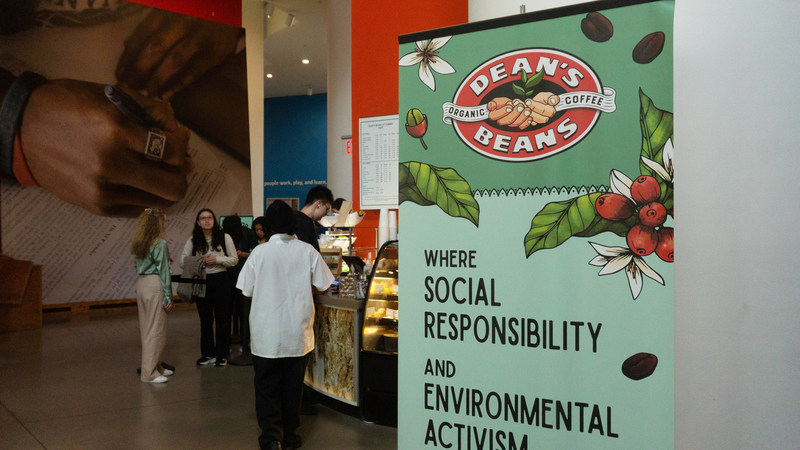
Students can now use meal swipes at Dean’s Beans in Stata
The multi-year project allows students to use swipes for grab-and-go meals





Levy Le–The Tech
On April 10, DormCon Dining Chair Eugenie Cha ’28 announced on dormspam that students would be able to use meal swipes to obtain grab-and-go meals at Dean’s Beans in the Stata Center from 10:30 a.m. to 2:30 p.m., Monday through Friday, starting April 13.
The project comes as a major achievement amid calls to increase access to food on the east side of campus, where no dining halls reside and food marketplaces (such as the one in Stata) are closed during prime dining hours in the evening.
According to Cha, the initiative has been in the works for several years, since before her time. “We have long wanted to bring swipes to Stata and have worked closely with Dining to make this a reality in several weekly meetings, endless student surveys, and cost analyses,” she wrote.
Also serving as a student representative on the Dining Advisory Group and the Food Security Action Team, Cha noted that the “food desert” on the east side of campus was a shared priority among students and dining-related MIT administrators. Cha cited initiatives across campus, such as the recent Building 4 Carolicious pop-up, as an optimistic sign of future projects to combat the issue.
DormCon previously coordinated with Mark Hayes, the previous MIT Campus Dining Director. Although Andrew Mankus took the reins in June 2025, Cha was excited to see that the project remained a priority of Dining.
In a statement to The Tech, Mankus credited several organizations with the successful launch of the Stata Grab-and-Go program, including Dining, the Undergraduate Association (UA), DormCon, Division of Student Life (DSL) business partners, and Bon Appétit, the Institute’s food vendor.
The project was also a top priority of UA President Alice Hall ’26, who met with Mankus as soon as he was available to discuss swipe usage on the east side of campus. “He has been awesome to work with because of his new ideas, energy, and communication regarding any obstacles,” Hall wrote.
Hall also met with several members of the MIT administration, including DSL Chancellor Suzy Nelson and the the Corporation Joint Advisory Committee on Institute-Wide Affairs in order to push eastside campus dining as one of the projects implemented this year. Last semester, the “grab-and-go” concept launched in the Baker House dining hall as a test for bigger projects. “That initiative was one I knew would help set the stage for similar pilots,” Hall said.
The success was not without its challenges. Anticipating widespread popularity, a primary concern was that Stata would not be able to handle a large influx of students at lunch time, especially considering the lack of kitchen space. Furthermore, Cha noted the difficulty in ascertaining how much food at Stata could be “reasonably equated” to a typical meal swipe and how this value system could be implemented across different contractors and vendors.
Aside from logistical issues, Hall also pointed out that obtaining campus-wide support was challenging, since swipe flexibility only affects undergraduate students. While Dining also supports graduate students and faculty, these groups often opt out of meal plans.
The project started with just 50 meals available, but will expand as student demand increases and the kitchen system and equipment are able to handle the volume, Cha said. In the future, DormCon hopes to introduce a hot bar menu as well with staples.
Similarly, Mankus affirmed Dining’s commitment to using student feedback and “operational expertise” to guide future improvements.
Christine Onianwa ’28 visited Stata for the opening of the new dining initiatives. Being able to use meal swipes was “very convenient,” given that most of her classes are either in or near Stata. Owianwa also noted having to frequently spend money on the food options there, many of which hover around or above $8 to $10 per item. In the future, Onianwa hopes the quantity of food will increase.
On launch day, demand was higher than expected, according to an email sent at 11:35 a.m. by DormCon President Diego Temkin ’26, with meals running out around noon, according to Onianwa. Mankus asked for “patience” as Dining calibrates the program, noting production capacity as a “key operational constraint.”
More generally, Cha hopes to address food security on campus, which has led to seed funding for dorm food pantries and communication with Concord Market on options and pricing. Hall also hopes to focus on affordable grocery accessibility, including in the Student Center and flexible Flex Dollar use in Cambridge.
The pilot also informs the Campus Dining Roadmap, Mankus added, which according to the DSL Dining website, aims to elevate dining and “better serve the needs of the MIT community.”
Students can send in feedback about the new Stata Grab-and-Go program at a QR code survey or to dormcon-dining-chairs@mit.edu.
A correction was made on April 16, 2026: A previous version of this article mispelled Mark Hayes's name as Mark Haynes. It has now been updated to reflect the correct name.