Service requested: A look inside MIT’s elevators
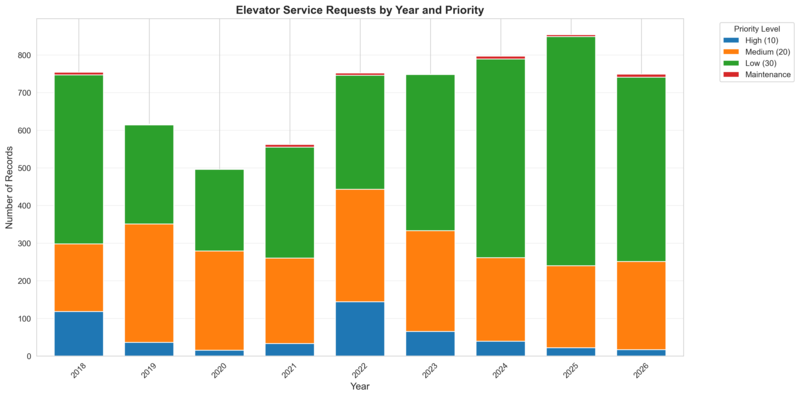
749 elevator service requests were logged between Jan. 2 and Sept. 20, 2026





Grace Zhang–The Tech
Grace Zhang–The Tech
In May, Graham Schmidt G was on his way to collect culture media in Building 18 when he got stuck in an elevator.
The doors closed, but the elevator didn’t move. Schmidt pressed a few buttons; nothing happened. Finally, he called for assistance and was told that help would be coming.
“Minutes passed — five, maybe ten. Eventually I got sick of waiting and pulled at the doors enough to squeeze through,” Schmidt said. “I didn’t wait to see if the technician made it or not.”
Schmidt’s experience is not unique. According to records obtained by The Tech, 46 service requests related to entrapment were logged between Jan. 2 and Sept. 20, 2026. During the same time period, The Tech identified 749 broader elevator service requests, including delays, outages, and other problems.
From 2018 to 2026, MIT community members submitted 6,329 elevator service requests, averaging around 700 requests per year. Aside from a dip from 2019 to 2021, the number of requests remained consistent.
But not every request is equal. According to Mike Smalley, director of Maintenance and Operations in Facilities, when a request is submitted, MIT Facilities prioritizes it based on factors such as access to alternate elevators and impact on users. In most years, maintenance and low-priority requests constituted the majority, while medium-priority requests were the largest share in 2019 and 2020. High-priority issues, meanwhile, represented around 3% to 19% of requests in a year.
Historically, service requests for elevators remained open — from submission to closure — for a median of 1.78 days and a mean of 13.58 days. According to Smalley, MIT’s investment in elevator maintenance has “significantly improved performance and reliability” over the past decade. Despite this, Schmidt has noticed that response times vary.
“The Building 18 elevators are never down for long, but other elevators take a long time to fix,” Schmidt said. “There was one stretch when [an elevator in Building 6] wasn’t working for at least a month.”
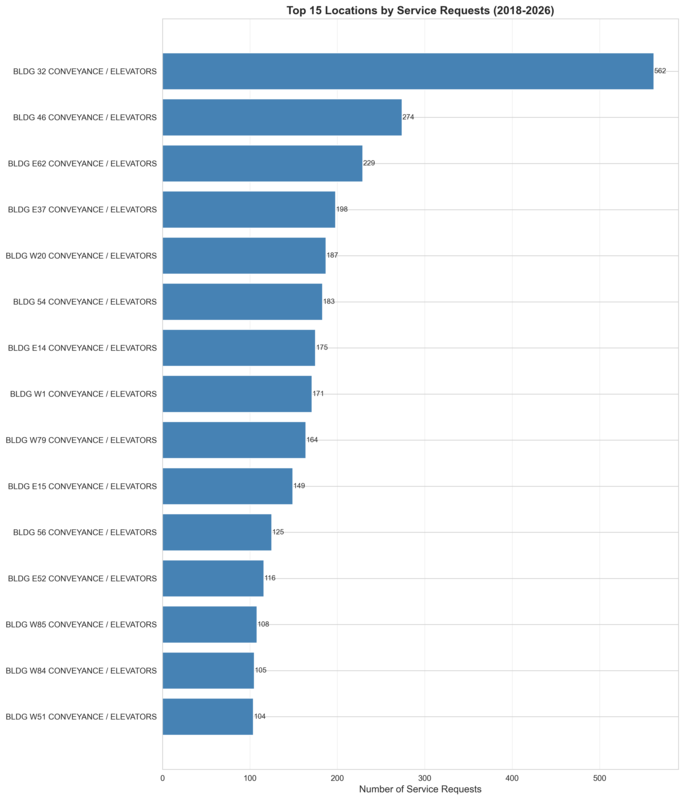
In the records, Building 32 (the Stata Center) had the most elevator service requests. Other notable locations included Building 46 (home to the Department of Brain and Cognitive Sciences), Building E62 (Sloan), Building E37 (Graduate Tower at Site 4), and Building W20 (the Stratton Student Center).
In addition to service requests and annual state-mandated inspections, a dedicated Facilities team works with technicians from elevator firm Schindler to perform regular maintenance, covering doors, brakes, cables, and safety features.
Such routine maintenance could take an elevator out of service. When this happens, Facilities notifies building managers and updates a running list of elevator outages on campus.
Notably, the two elevators in the Student Center were alternately out of service at the beginning of this month for “planned replacement of the steel cables that support and move them,” Smalley wrote. Both are now operational again.
For some students, elevator outages can significantly impair accessibility.
“If you need the elevator because you are on crutches, wheelchair, or need to move things, then this definitely impacts [your] experience negatively,” Vivian Hir ’25 MEng ’26 pointed out.
Associate Dean and Director of Disability and Access Services Mary Ellen Vigeant wrote that her office is committed to supporting students with disabilities regarding accessibility issues.
“If the path of a student with a disability is hindered by a closure of an elevator, we encourage them to reach out to our office to discuss ways we may be able to help,” Vigeant stated. She cited Facilities’s aforementioned outage list as a resource to inform alternate routes.
Smalley encouraged community members to report problems when they encounter them, which can alert Facilities to problems earlier.
“The best way to report a problem is to alert your building manager or the MIT Customer Service Center (617-253-4948, dof-csc@mit.edu),” he wrote. “Include the building number, the elevator car number, and what you noticed.”
Disclosure: Graham Schmidt G, a prospective news staff member, and Vivian Hir ’25 MEng ’26, a former news editor, were interviewed about their personal experiences with MIT elevators. Neither was involved in the writing or editing of this article.