Collaboration: The cornerstone of innovation at MIT
The MIT Future Fest is the result of collective action to enhance our understanding of the world around us





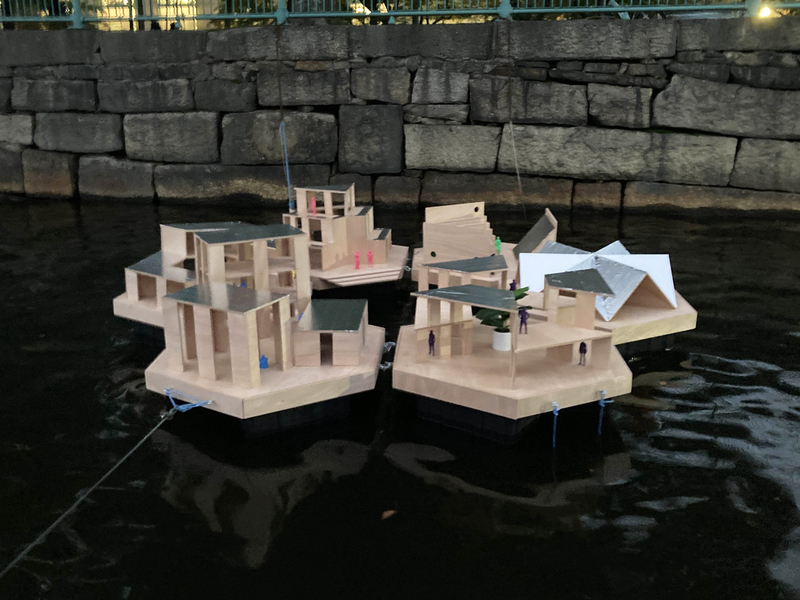
Conrad Straden–The Tech
How do we know an ocean we cannot see, hear, or listen to?
From Sept. 30 to Oct. 4, MIT Future Fest set out to answer these questions and many more. One element of the five-day science festival was the Crochet Coral Reef exhibit. As part of a wider project, sisters Margaret and Christine Wertheim filled the MIT Museum OCEANS exhibit with loops of yarn representing models of hyperbolic geometry. The sisters designed pieces as grand as the Coral Forest and as tiny as Pod Worlds. One forest was made of plastic, exploring the threats of an imperishable future. Another, designed by Professor of Computer Science Erik Demaine and his father, Angelika and Barton Weller Artist-in-Residence Martin Demaine, was made entirely out of paper.
Although these showcases highlighted MIT as a hub of innovation and discovery, they were not purely for the fun of the exhibition. In May 2026, MIT President Sally Kornbluth announced that MIT had experienced a decline of over 20% in research activity funded by the federal government. At a time when universities are being targeted, MIT Future Fest can be seen as an opportunity to build public support and long-term investment in scientific research.
Interwoven throughout the events at Future Fest was the need for collective action among artists, scientists, and technologists. In her talk, Apollo Program Professor of Astronautics Dava Newman SM ’89 Ph.D. ’92 spoke on this collective action, explaining that scientists identify promising signs of life on distant planets, while artists help us envision what these planets may look like. In order to reach its full potential, science also needs good communicators and storytellers.
“I don’t filter anyone out,” Newman said. “Now we filter everyone in. It’s all about the people.”
Deeper into the MIT Museum, explorers experienced the museum’s new OCEANS season. Sensing Oceans, which opened in late September, moves between science, technology and art: underwater sensing equipment and autonomous vehicles are part of researchers’ effort to translate an environment largely beyond direct human perception. One of the exhibition’s main attractions is the premiere of Marshmallow Laser Feast’s Seeing Echoes in the Mind of the Whale, an immersive video experience based on deep listening and oceanic research that explores the senses of three whale species.
How can we protect our planet, and with that, future generations?
This was the center of a conversation between Newman and artist and Tufts University Professor of the Practice Mary Ellen Strom. Named “Humanity Becoming Interplanetary,” this event promoted the idea that, to become great stewards of earth, we must look to space for answers.
“We’re at our best [when we are] looking out, searching out,” Newman remarked, discussing the colonization of exoplanets. She explained that out of the 6,000 exoplanets we know exist, 24 are quite similar to Earth. Future human settlement on exoplanets can increase humanity’s chances of survival by reducing our dependence on a single planet.
Referring to planetary travel, Newman noted, “This is the dream. This is the philosophy” only attainable through “spontaneous cooperation.” To help realize this vision, Newman’s lab invented the BioSuit, a skintight spacesuit that applies pressure directly to the body instead of enclosing the astronaut in a separate pressurized shell.
In the same vein, each panelist at the “The Next 250 Years” shared their own vision for improving humanity’s future. Moderated by Managing Director at Link Ventures John Werner and CSAIL director Daniela Rus, this event featured short conversations with 12 industry leaders, who projected optimism on the possibilities humankind can unlock.
Philip Johnston, CEO of Starcloud — a space technology start-up building AI data centers in orbit around Earth — promoted a vision of space data centers. Johnston believes that space is the best way to upscale computation due to the abundance of solar energy and stable thermal environment in space.
David Kong ’01 SM ’04 PD ’08 Ph.D, the director of the Media Lab’s Community Biotechnology Initiative, discussed ways to make biotechnology more accessible to the general public. These initiatives can empower the broader community to collectively solve global challenges and accelerate scientific progress.
Ultimately, Future Fest’s own organization embodies this principle of collaboration. The result of a joint effort between the MIT Museum, the MIT Technology Review, and MIT Morningside Academy for Design (MAD), Future Fest featured the opening of the MET Warehouse, which is the new home of MIT’s Department of Architecture and Planning.
Lauren Witte, the program coordinator for MIT DesignX, an innovation hub based in MAD, spoke about her experience volunteering at Future Fest: “It’s exciting to see everyone come experience what the MET Warehouse is meant to be — a space for design and creativity and collaboration, not just within MIT, but in the surrounding community as well.”
MIT Museum Director Michael John Gorman cited the enthusiasm of the faculty as a big reason for the success of this event, stating that they “shared this idea that it’s an important time for the university to engage outward.”
Future Fest places people at the center of scientific exploration, as opposed to treating them as bystanders. “There are many conferences around the world about future and future tech, and so on, but where else can you actually go into the labs, explore what’s going on, and actually have people creating things during the festival?” Gorman asked. “I think that’s very special.”