Inventing ELIZA: how the first chatbot transforms perceptions of AI
An author meeting with artist Peggy Weil — and the world’s first chatbot





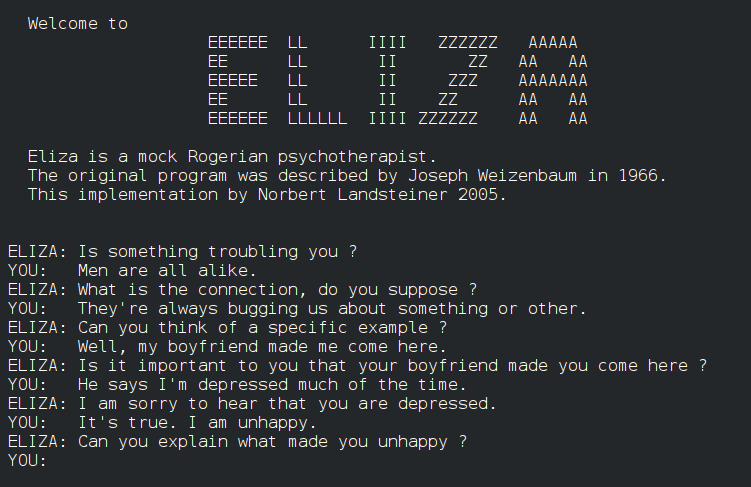
Photo from Wikimedia Commons (Public Domain)
ELIZA begins every conversation in the exact same way: “HOW DO YOU DO. PLEASE TELL ME YOUR PROBLEM.”
ELIZA isn’t a person. It’s the world’s first chatbot, designed in the 1960s by MIT computer science professor Joseph Weizenbaum. On Oct. 22, ELIZA appeared on a laptop screen in the MIT Press Bookstore. Peggy Weil SM ’82, an artist and a coauthor of the recently published book Inventing Eliza: How the First Chatbot Shaped the Future of AI, invited attendees to try out ELIZA for themselves at her author meeting.
One participant typed, “My problem is that I’m hungry.”
“IS IT BECAUSE YOU ARE HUNGRY THAT YOU CAME TO ME,” ELIZA responded.
“No.”
“ARE YOU SAYING ‘NO’ JUST TO BE NEGATIVE”
The participant chuckled and typed, “No, I came to you to experience talking to you.”
“YOU ARE BEING A BIT NEGATIVE”
Inventing Eliza is an interdisciplinary book with a team of eight authors, including cognitive scientist Jeff Shrager, literature professor Mark Marino, philosopher Peter Millican, and “software archaeologist” Arthur Schwarz. Weil stressed that the book is “multimedia.” She opened a copy, pointing out the blocks of code — complete with detailed in-line comments — among the pages.
Inventing Eliza “isn’t exactly light reading,” she explained with a laugh. “You’re not necessarily meant to read the book from beginning to end.” She turned to a new page: another snippet of code, along with ELIZA’s dialogue in large, red font. “Code as literature,” she said.
Peggy Weil is a multidisciplinary artist and a member of the MIT Media Lab. Why is she fascinated by chatbots?
Perception and illusion
A throughline of Weil’s art focuses on “perception and illusion.” Her project 3D Wallpaper (1976 and 2018) creates an illusion of depth on a flat surface. Camera Obscura (1978) shows the Empire State Building upside-down, a reference to the way our brains process visual information. 88 Cores, which premiered in 2018 and takes viewers through 110,000 years of the Greenland Ice Sheet, focuses on our perception of time and our difficulties with processing immense timescales.
What do chatbots have to do with perception and illusion? It’s the illusion of ELIZA as a human that intrigues Weil. She explained the ELIZA effect: a tendency to project human traits onto machines, even when the machines are quite basic.
Weizenbaum, ELIZA’s developer, saw the ELIZA effect in action. “[His] own secretary would ask for privacy to talk to it!” Weil exclaimed, “As if it was human!”
One participant who tried out ELIZA at the event complained, “She’s judging me!”
ELIZA is a rudimentary program, using around 420 lines of code to rephrase the user’s replies into questions. When those 420 lines of code can’t parse a user’s response, ELIZA falls back on one of four hard-coded phrases: “I SEE,” “HMM,” “GO ON, PLEASE,” and “PLEASE CONTINUE.” Even so, ELIZA creates a surprisingly strong illusion of a conscious listener.
In the 1960s, the strength of the ELIZA effect took Weizenbaum by surprise. After he explained the “trick” to users, even showing them the code, they still seemed to experience a connection with it. He was deeply troubled as peers began suggesting using bots for therapy.
“The idea that [his] work would be… inserted in the most human of relationships was an… anathema to him,” Weil said.
Weil is especially interested in how the interface of a chatbot affects the user’s perception of the conversation.
“When younger people think of bots, they think of screens and phones, not pieces of paper being printed out,” she said.
She directed attendees to findingeliza.org, a site created by the same team of eight authors. Across eight different user interfaces — from the original 1966 Teletype 33 interface to early 2000s instant messages to a modern ChatGPT interface — users can chat with the same original ELIZA. Weil invited the users to reflect on how these different interfaces affected the ELIZA experience. Did ELIZA in a Twitter comment feel more human than ELIZA in a 1960s terminal?
To understand chatbots, simplify them
As a young art student at Harvard, Weil had built a room-sized camera obscura: a dark chamber with a small hole that projects an image onto a surface, like a basic camera. She projected a large image of Harvard’s church steeple onto the room’s wall. Understanding the very basics of camera technology allowed her to gain a deeper understanding of visual perception.
Analogously, “thinking about an early, hand-coded AI is instructive for thinking about more complex, modern cases,” she explained.
To understand ChatGPT, it is necessary to first understand “much more simplified chatbots.” Modern chatbots can feel like magic tricks to users, but Inventing Eliza helps the reader peek under the technology’s hood by examining its earliest forms.
Of course, ELIZA does not work the same way that modern LLMs do; it relies on hard-coded formulas and a predetermined set of trigger words, not vast datasets and machine learning. Even then, Weil sought to show her readers how similar the psychological effects on the user are. Whether we’re chatting with ELIZA or Claude, our brains are imagining more than a machine.
ELIZA: A Rogerian therapist?
Weil encouraged listeners to reflect on ELIZA’s ripple effects: how early design choices in primitive chatbots influence how chatbots are made and used today. She explained that Weizenbaum designed ELIZA with a specific style of therapy in mind: Rogerian, or person-centered, therapy.
In Rogerian therapy, developed by Carl Rogers in the 1940s, a therapist is meant to be empathetic, accepting, and nondirective. The therapist’s goal is to listen without judgement, focus on the patient’s present feelings and experiences, and help the patient feel seen. In Freudian therapy, by contrast, the therapist’s role is to find patterns, explore unconscious belief systems, and examine childhood experiences. The therapist’s style might be analytical and interpretive, rather than warm and personal.
Inspired by Rogerian therapy, ELIZA is designed to validate users’ experiences and feelings, reflecting their own words back at them. Tell ELIZA “I feel depressed,” and it responds: “TELL ME ABOUT SUCH FEELINGS.” Tell it “My family doesn’t understand me,” and it responds: “YOUR FAMILY DOESN’T UNDERSTAND YOU.”
Weil wonders: what if ELIZA had been modeled after other styles of therapy, like Freudian therapy? Would modern chatbots sound different? One attendee speculated: “Maybe they wouldn’t be so sycophantic. Or maybe, they would tell you that you want to kill your father and marry your mother.”