Latin American board games bring students back to their childhood
CAFE, APR, and CASA helped students take a break in the Wellbeing Lab





Hana Sousa–The Tech
Hana Sousa–The Tech
From the outside, MIT students seem to have dedicated their entire lives to problem-solving and innovating, from solving triple integrals and prototyping a nuclear reactor in their garage to harvesting drinking water from air. However, they were also once kids, playing hopscotch or Mikado with friends.
On Oct. 17, the Central American and Caribbean Friendship & Engagement (CAFE), Association of Puerto Rican Students (APR), and Cuban American Student Association (CASA) helped students feel like children again. The Wellbeing Lab (W20-308) was divided into eight islands: six for traditional Central American and Caribbean board games, one for prizes, and one for beef, cheese, and chicken empanadas.
Sebastian Aravelo ’27, treasurer of CAFE, shared that the club is committed to organizing at least one event per semester with the Wellbeing Lab. Aravelo appreciated the collaboration, not only for the convenient space, but also for the financial support through the Weekends@MIT fund.
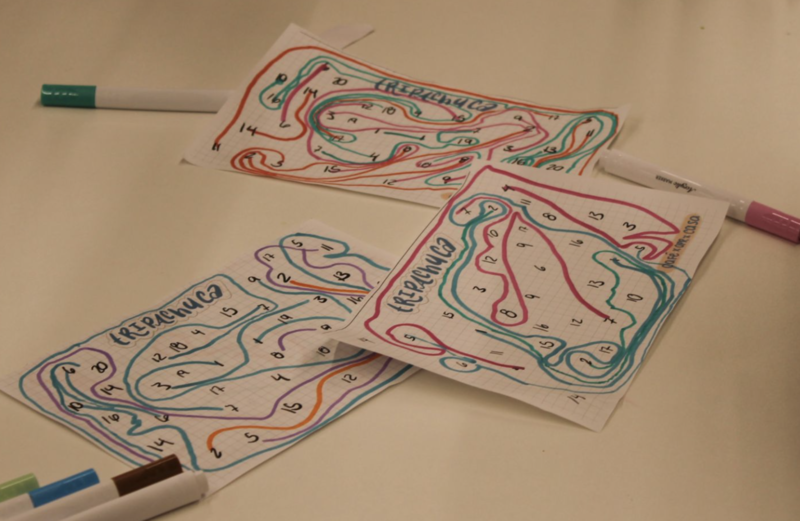
For each game played, students gained points that were later converted into tickets for a raffle of plushies, a Lego set, an instant camera, and a power bank. The goal was to encourage students to try all the games. Closest to the entrance was Tripa Chuca, a Salvadoran drawing game for connecting pairs of numbers. The students started with the lowest number, and if they drew a line above one that was already drawn, they lost the round. The play then passed to the next student, who connected the following number. The last player standing won. (I never managed to win.) Tripa Chuca may be simple, but it takes strategy to draw lines that challenge others without trapping yourself.
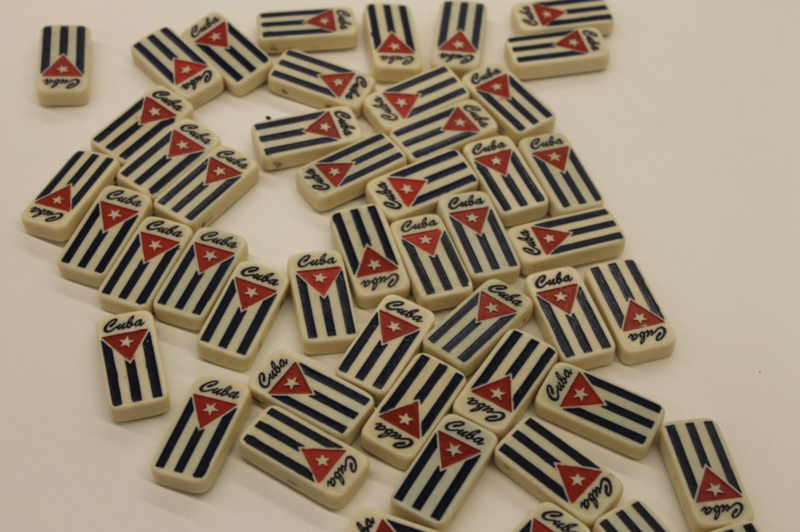
At other tables, students played dominoes, Palitos Chinos (Mikado), and the card game cassino. On the floor, some students played Jackses, the Costa Rican version of knucklebones, where the player tosses a ball in the air and has to scoop up pieces from the ground before the ball bounces. In the middle of the room, a grid of rectangles was outlined on the ground with tape, inviting players to alternate jumps on one foot or two. As a Brazilian, I would call it amarelinha (little yellow), while Aida Mitroi ’30 would recognize it by the Romanian name, șotron. At this event, however, rayuela was the Spanish word used to refer to this game, known in the U.S. as hopscotch.
Mitroi, who won one of the prizes, described the game night atmosphere as very warm. The games reminded her of her childhood in Romania, where she played similar versions with slightly different rules alongside her mom. Her favorite part of the event was that “the games we played seemed to have no specific cultural roots.”
The event was also enjoyable for the organizers, who carefully selected the games to represent Latin America and, more importantly, take students back to their childhood. Kristel Acuña ’27 was proud of the collaboration that made the event possible: “We had the perfect mix of Central American, Puerto Rican, and Cuban food and traditional games that made us all feel close to home.”
The president of CAFE, Avril Cruz ’28, explained that midterms week hindered the brainstorming and game selection process. Nevertheless, the event turned out to be a success.
“It felt like a break from everything that was going on academically,” Cruz said, adding that cultural organizations can easily get into the mindset of hosting events just for the sake of hosting events, to get more funds so they can make more events.
Cruz highlighted that this one was special. “It felt social, and so fun, even for the organizers.”