Surveillance expansion inspires debate and decoration
MIT announces it is no longer exploring AI capabilities in security cameras





Graham Schmidt–The Tech
Graham Schmidt–The Tech
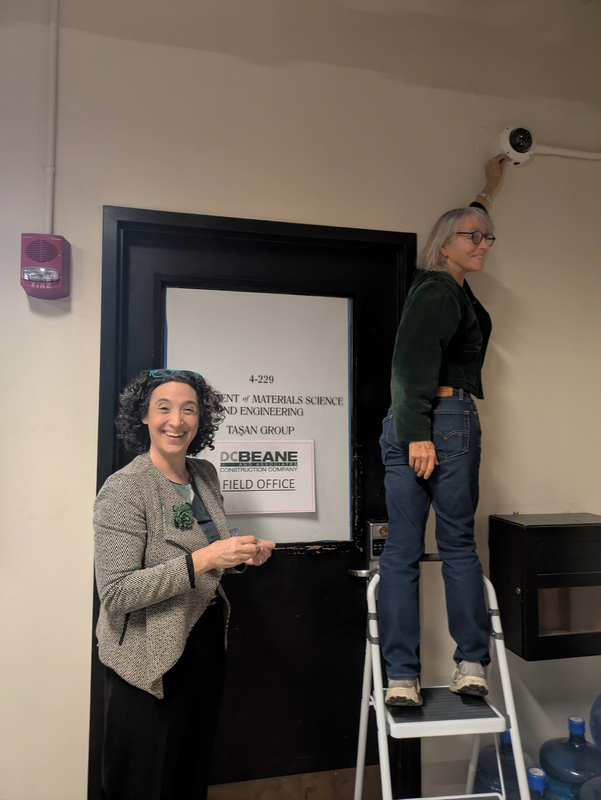
On a recent Tuesday evening, Marah Gubar, associate professor of literature, and Nancy Kanwisher, professor of cognitive neuroscience, chatted in Gubar’s office. They were waiting for a stepladder. In order to reach campus security cameras, which are typically installed a few feet above head height, they needed a lift.
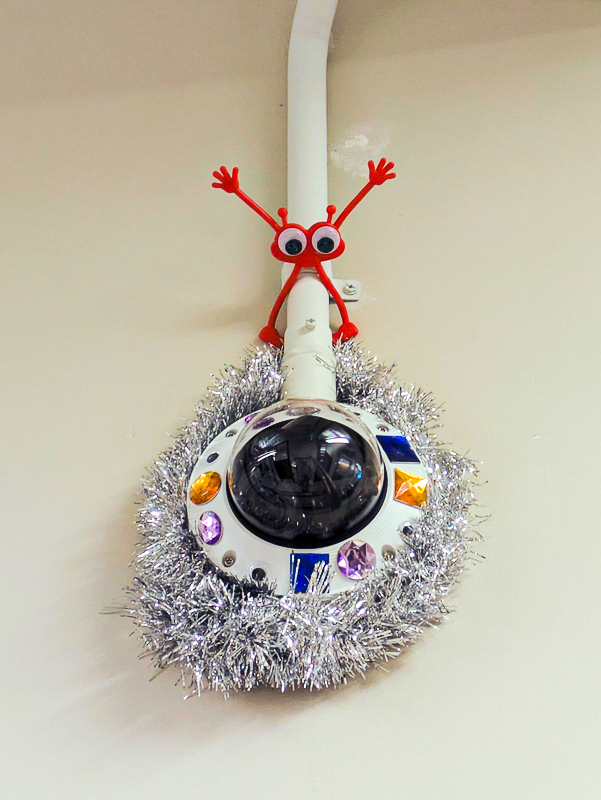
A friend swung by to drop the ladder off, and they set out in search of surveillance. Gubar spied an inconspicuous camera in the corner of a large door frame. As Kanwisher climbed up and began applying stickered gemstones, googly eyes, and ribbon, MIT President Sally Kornbluth walked past. Gubar waved and offered her a bendable, googly-eyed rubber figure.
“Is this symbolism?” Kornbluth asked, smiling and tucking the figure away in her bag.
It was. Since August, Gubar and four other tenured professors have been leading field trips around campus to bedazzle cameras. The project, accompanied by a satirical article in the September/October issue of the Faculty Newsletter (FNL), is a protest against the installation of new AI-capable security cameras on campus in the last year.
In an interview with The Tech, Gubar said that the bedazzling is “aimed at raising awareness about the major change that just got imposed on our campus without any meaningful consultation with the MIT community.”
“We figured the cameras should be made visible,” Gubar added.
The campaign to add new cameras, which began in November 2025 and was previously covered by The Tech in April, cost more than $3 million and brought more than 500 additional cameras to campus. In a presentation given by Executive Vice President and Treasurer (EVPT) Glen Shor at the May faculty meeting, Shor said that MIT also conducted a limited trial, involving 25 cameras, of software from AI security company ambient.ai, which had concluded by then. The expansion of campus security was meant “to close key gaps in coverage that became apparent during recent investigations” into crime on campus, according to a FAQ page on the EVPT website.
The day after their encounter in the hallway, Gubar, Kanwisher, and Kornbluth were in the same room once again for the October faculty meeting, where Shor announced a “pause” on the analysis of deploying AI capabilities. And on Oct. 27, Shor made that update public on the EVPT website, stating unequivocally that cameras on campus would continue to operate “with no AI, no audio recording, and no facial recognition,” and that MIT would not explore these features in the future.
However, the new cameras remain, as does the broader debate about campus surveillance.
Cameras on campus
There are around 4,600 cameras on MIT campus, according to the EVPT FAQ. Most of these cameras monitor exterior locations, emergency phones, and critical infrastructure, like MIT’s nuclear reactor.
The recent increase in the number of cameras has been concentrated in non-residential hallways, stairways, lobbies, and entrances. Cameras in these areas more than doubled in 2025, from fewer than 400 to more than 800, based on figures from Shor’s presentation at the October faculty meeting.
Many faculty members, including the authors of the FNL article, first learned about the expansion in campus monitoring from The Tech’s reporting. Shor addressed questions about these changes at the May faculty meeting, where a few faculty members expressed a variety of concerns, including about data security and lack of consultation with MIT professors who are experts on AI.
Marzyeh Ghassemi, an associate professor at CSAIL who studies social bias in machine learning, is one such expert. At the May meeting, she pointed out that stored surveillance data can be subpoenaed, as MIT footage was in the aftermath of the Boston Marathon bombing, and that cloud-based security camera systems have been the targets of successful cyberattacks. MIT says that footage is retained for only 30 days, unless it is being reviewed, or keeping it is required by law. Contracting with a third-party company, however, could lead to video leaving Institute servers, according to Ghassemi.
In an interview with The Tech, Ghassemi again stressed these issues. She also voiced concerns about the decision-making process.
“We really need more information,” she said, referring to the Institute’s rationale for expanding camera coverage and testing AI. “I’d like to see some data support. This is MIT. Surely there’s some data, right?”
After the May faculty meeting, the office of the EVPT established an advisory committee to consider the use of AI in reviewing footage and identifying safety hazards in real time. Ghassemi was invited to join. According to her, they met only once, on Aug. 25.
The committee was established only to advise, without any decision-making power. Its scope was also limited to the deployment of AI. Decisions about cameras are made by the Campus Safety Working Group, which includes members from the Provost’s Office, Campus Planning, MIT police, and Information Services and Technology (IS&T).
Watching the watchers
Catherine D’Ignazio, an associate professor of urban science and planning, told The Tech that she lobbied to be part of the advisory committee. D’Ignazio studies the social and ethical implications of technology, focusing on data literacy and civic engagement. She has worked as a software developer and as an artist and designer, and holds an MFA from the Maine College of Art.
When she wasn’t selected, D’Ignazio said, “I put my artist hat on, and recalled a project by an MIT alumna, Jill Magid.”
In 2002, Magid applied adhesive rhinestones to CCTV cameras at the Amsterdam Police headquarters amid widespread discussion of surveillance in the wake of 9/11. Inspired by Magid’s project, D’Ignazio, Gubar, and the other authors of the FNL article began their decorative excursions in August.
Bedazzling has become a near-weekly event for a small but growing group of participants who plan outings and share related news on an internal MIT email list. They decorate about seven or eight cameras per trip. Although some of the decorations have since been taken down, dozens of cameras around campus are now very hard to miss.
The project has started to gain visibility off campus, too. Local media outlets, including Cambridge Day, MassLive, and the Boston Globe, have reported on the project. New York Times reporter Natasha Singer, who covers technology in higher education, joined Gubar and Kanwisher after giving a talk at CSAIL, and posted about it on Bluesky.
D’Ignazio said the responses she has received have been largely positive. Students have joined her on several outings, including one who had previously bedazzled on her own.
She has also heard from some faculty members who were “very pro-surveillance cameras,” she said.
“I don’t know that any of us who are in the bedazzling crew would ever say we want no surveillance on campus. It’s a way of starting the conversation that the administration did not give us a chance to have,” D’Ignazio explained.
Yossi Sheffi, professor of engineering systems and director of the MIT Center for Transportation and Logistics (CTL), is pro-surveillance camera. The CTL has recently installed their own cameras, which are connected to the MIT surveillance system, and restricted card access to their offices, after two incidents in which protesters disrupted conferences in the Center.
Sheffi first learned about the new cameras after reaching out to MIT police last year in the aftermath of the Brown University shooting and the murder of MIT professor Nuno Loureiro. (MIT began adding new cameras last November, before the shootings.)
“I’m all for it,” Sheffi told The Tech. “Privacy versus security — in my mind, security wins.”
Sheffi believes that AI could be a useful part of the campus security system, although he had not heard about MIT’s trial with ambient.ai. MIT does not “proactively monitor security footage on a real-time basis except in very limited circumstances,” according to the EVPT website.
“But that’s why AI is so good,” Sheffi said. “Because it can.”
Student voices
Strong feelings about campus surveillance are not limited to MIT faculty. Student groups have also publicly objected to the expansion of the MIT security net, and in particular to the possible use of AI.
In October, the MIT Undergraduate Association (UA) and the Graduate Student Council (GSC) passed a joint resolution on AI in security cameras. The UA and GSC called on MIT to provide justifications for the use of AI, to put forth transparent policies on data retention and sharing, and to establish a committee with real authority.
Eric Lu G, president of the GSC, said that he and other members of the GSC noticed the new cameras going up at the beginning of this year. But they became concerned after hearing that the Institute might start to use AI software.
Like some faculty members, the GSC has also been frustrated by the organizing process for the AI advisory committee. After a graduate student on the committee graduated, the GSC was asked to fill the empty seat. Before the council chose its nominee, however, the administration changed its mind and picked someone else. Only after Lu threatened to escalate was the GSC’s representative allowed to join the committee.
AI surveillance has been the subject of recent picket-line chants, too. MIT’s Graduate Student Union (GSU), which recently voted to authorize a strike, has been bargaining with MIT since April to replace its previous contract, which expired at the end of May. In some of its proposals, the GSU included language that would forbid MIT from using AI to monitor, evaluate, or discipline graduate student employees.
Daniel Shen G, the GSU campus chief steward, told The Tech that AI-enabled surveillance is an important issue for the union. “We remain quite concerned that MIT could use these technologies to discipline workers on the job site,” he said. “We haven’t seen a compelling reason as to why they need AI.”
Gubar, who has served as a faculty advisor to students in past Committee on Discipline (COD) cases, also has concerns about the use of footage in student discipline. She recalled a troubling instance of video sharing between the MIT police and the Cambridge City Police in connection with a hack by an MIT student, for which the student was criminally charged. And in emails obtained through the discovery process and later shared with Gubar, MIT police were willing to pass along surveillance data unrelated to criminal behavior. In an email correspondence with Cambridge City Police officers, whose names were withheld by Gubar, an MIT police officer offered to share images of “individuals that have been active in protests on campus.”
Over the summer, Gubar and the other authors of the FNL article also noticed changes to IS&T policy on security cameras. Previous language limiting the sharing of footage was relaxed, and a line barring the use of footage for disciplinary matters was removed.
These applications of surveillance, D’Ignazio says, contribute to a “climate of fear and repression right now on campus.”
“I think there’s a cost on the creative side,” D’Ignazio added.
Some students who have expressed support for the bedazzlers have told her that they are apprehensive about participating, even though D’Ignazio and her coauthors are careful not to interfere with the functioning of the cameras. When the students do join, they usually hand out fliers while the tenured faculty do the decorating.
The October faculty meeting
Tension over surveillance came to a head at the October faculty meeting. Shor was scheduled to provide an update on the Institute’s security camera program, the last item on the agenda. But the debate started early, during the discussion period for the COD’s annual report, when D’Ignazio requested clarification on the rules for camera footage in disciplinary cases.
Spirited discussion ensued, including a motion to add COD rules restricting the use of video evidence. Due to time limitations, those present agreed to postpone the conversation to the November faculty meeting.
That left time for Shor to present the Institute’s latest position on security camera policy. After consulting with students, faculty, administrative staff, the MIT Corporation, and others in the community, Shor said, “We see that using AI would give rise to more complex issues.”
Shor announced a “pause” on the Institute’s analysis of AI-enabled surveillance at the meeting, which has now been extended indefinitely. But he also defended MIT’s existing network of cameras.
He stressed that many in the community feel safer with more comprehensive surveillance coverage, and pointed out that cameras are an important tool for MIT police, which used surveillance footage in 240 of the 543 investigations they conducted in the last year. Shor also said that the rewording of IS&T policy was meant to transparently reflect current practice. The COD rules have contained no provisions banning recordings in disciplinary hearings since at least 2013, although their use is rare. Tamar Schapiro, professor of philosophy and the current COD chair, said at the meeting that there has only been one such case during her tenure.
The day after the meeting, in an email to graduate students, Lu called the pause “a positive step from the MIT administration.” But he reiterated concerns about the decision-making process, and the continued relevance of the GSC’s joint resolution with the UA.
Gubar was also cautiously optimistic. “I’m very pleased that, as a result of student and faculty pushback, they’re at least hitting pause for now,” she told The Tech soon after the October faculty meeting. “But I’m concerned about the future.”