Jury awards former MIT professor David Sabatini $6 million in sexual harassment defamation suit
Both Knouse’s and Sabatini’s lawyers intend to seek further legal action





Suffolk County Superior Court
Grace Zhang–The Tech
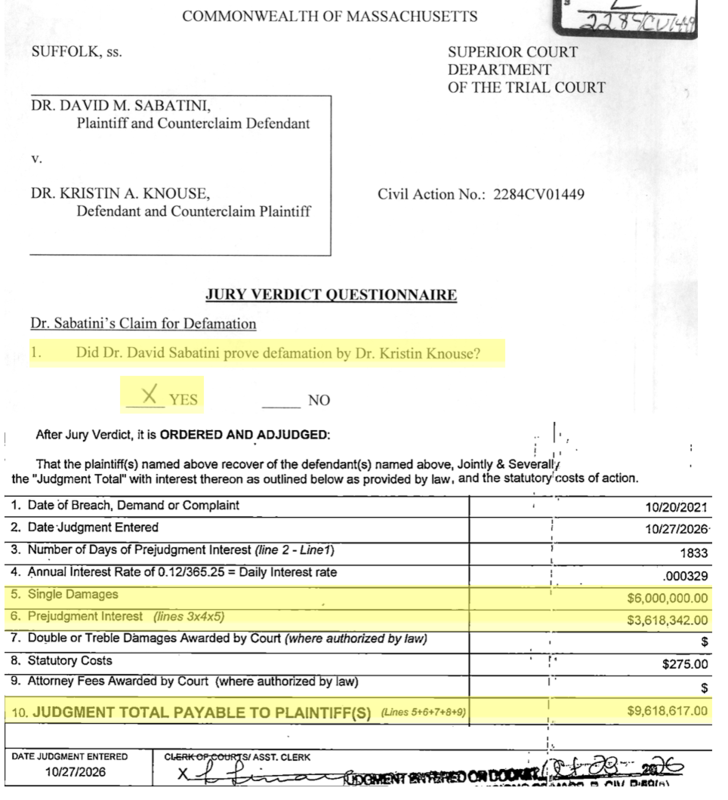
On Oct. 16, former MIT biology professor David Sabatini was awarded $6 million in damages after a Suffolk County jury found MIT assistant professor Kristin Knouse PhD ’16 liable for defamation against Sabatini and determined she had interfered with his ability to make a living. On top of the $6 million verdict, Knouse is expected to pay about $3.6 million in prejudgment interest, amounting to a total of around $9.6 million.
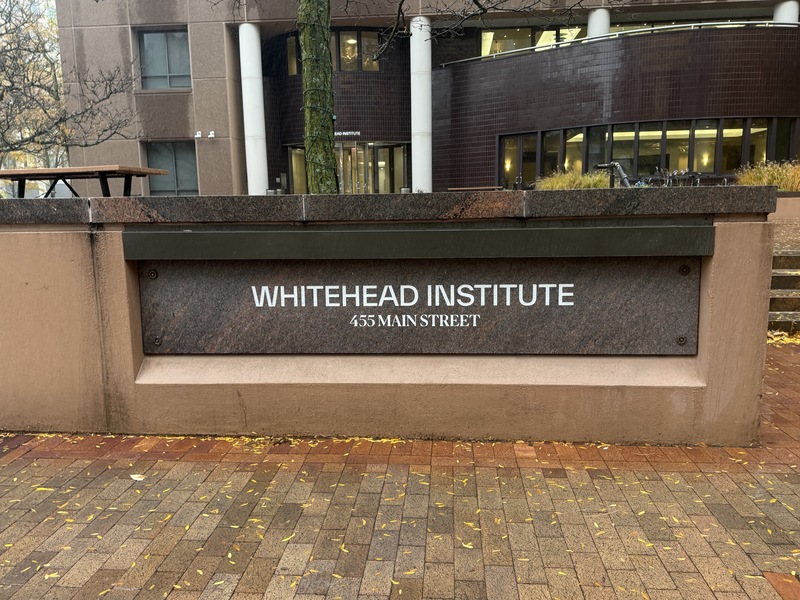
In 2021, Sabatini resigned from the Whitehead Institute following an investigation into the workplace culture of his laboratory. The investigation concluded that Sabatini’s lab promoted a sexualized environment. Sabatini was also fired from the Howard Hughes Medical Institute (HHMI), a nonprofit organization that funded Sabatini’s research.
Consequently, Sabatini sued Knouse, Whitehead, and Whitehead Director Ruth Lehmann for defamation and other claims in 2021. Knouse filed a counterclaim against Sabatini for sexual harassment. Sabatini claimed that the relationship was consensual, stating that Knouse took action against him after he became romantically interested in another woman. Meanwhile, Knouse claimed that the relationship was coerced. All claims made by Sabatini against Whitehead have previously been dismissed by the Court.
Leading up to the verdict
In this case, the jury found that Knouse “tortiously interfered with his [Sabatini’s] contractual relationships” (Whitehead, MIT, some biotech companies) and “prospective advantageous relationships” (New York University and the Sloan Kettering Institute). The jury rejected Knouse’s counterclaims of Sabatini engaging in quid pro quo sexual harassment, which created a “sexually hostile work environment,” and retaliating against her. As indicted by the jury verdict questionnaire, Knouse failed to establish that sexual harassment took place, but no judgement was made as to the nature of her and Sabatini’s relationship.
Five years ago, on Oct. 20, 2021, Sabatini filed a complaint against Knouse, Lehmann, and the Whitehead Institute. Citing loss of livelihood, his professional reputation, and “devastating emotional damage and economic loss” as a result of the Whitehead investigation, he laid out six counts against them.
Sabatini alleged that Knouse made false and defamatory statements to Lehmann, the attorneys involved with the investigation, and other associated parties “negligently,” tortiously interfered with his employment relationship with Whitehead, HHMI, and MIT, and intentionally inflicted emotional distress.
He also accused the Whitehead Institute and Lehmann of defamation on the basis they published statements concerning the nature and outcome of the investigation, which “conveyed or were based upon false facts” and falsely stated to prestigious publications and Sabatini’s co-authors that he was “no longer affiliated with MIT,” leading to tortious interference with these “advantageous relationships.”
On Dec. 7, 2021, the court received Knouse’s counterclaim, where she alleged that Sabatini had created a “highly sexualized and offensive lab environment,” had manipulated and “improper[ly] groom[ed] young women who have sought him out for training and support,” and threatened to retaliate against “anyone who has dared to cross him.”
Knouse leveled six counts against Sabatini, accusing Sabatini of creating a hostile work environment due to “frequent and severe unwelcome and offensive sexual and gender-biased conduct and comments,” engaging in “retaliatory conduct” during the Whitehead’s investigation and in filing the lawsuit in 2021, and committing “assault and battery” during non-consensual sex. In addition, Knouse accused Sabatini of interfering with advantageous relationships.
On Nov. 3, 2025, the judge allowed Whitehead and Lehmann’s motion for summary judgment on Sabatini’s claim for gender discrimination, effectively removing them from the case.
Background of the relationship
In 2010, Knouse began a joint M.D./Ph.D. program at Harvard and MIT. In 2012, she met Sabatini when she began her graduate studies at MIT. Sabatini was on Knouse’s thesis committee. In 2016, Knouse completed her Ph.D. She officially received her M.D. degree in May 2018, and was named a Whitehead Fellow with Sabatini’s letter of recommendation.
From April 2018 to January 2020, Sabatini and Knouse had a sexual relationship; at the time, Knouse was a Whitehead Fellow and Sabatini was the director of the Whitehead Fellows Program.
The relationship overlapped with the implementation of MITs Consensual Sexual or Romantic Relationships in the Workplace or Academic Environment policy in January 2018; specifically section 9.9.5, which prohibits members of the MIT community with “supervisory responsibility” over another member of the MIT community from having a sexual or romantic relationship with that subordinate. All Whitehead faculty are also members of the Department of Biology or other departments at MIT and thus are subject to MIT’s policies.
If a relationship develops, the supervisor must withdraw from any supervisory or evaluative functions for that subordinate and must notify their own supervisor. According to a memorandum, when investigators from the law firm Hinckley, Allen & Snyder LLP asked Sabatini about the relationship, he “initially denied it, but ultimately conceded.”
MIT spokesperson Kimberly Allen referenced a 2022 letter that former President Rafael Reif sent to faculty regarding Sabatini’s decision to resign from MIT. Reif said that the reviewers (former Biology Department Head Alan Grossman, current School of Science Dean Nergis Mavalvala PhD ’97, and former Provost Martin Schmidt SM ’83, PhD ’88), who recommended that Sabatini’s tenure be revoked, found his behavior a violation of MIT’s Consensual Sexual or Romantic Relationships in the Workplace or Academic Environment policy.
“Specifically, the reviewers found Professor Sabatini engaged in a sexual relationship with a person over whom he held a career-influencing role, he did not disclose the relationship at any time to his supervisors, and he failed to take any steps to relinquish his mentoring and career-influencing roles,” Reif wrote.
Following Sabatini’s departure from the Institute, NYU’s Grossman School of Medicine considered hiring Sabatini in 2022. However, the news was met with backlash from students and faculty, causing NYU to not hire Sabatini. Despite the controversy, Sabatini received funding from billionaire Bill Ackman in 2023, allowing him to open a lab in the Institute of Organic Chemistry and Biochemistry (IOCB) at Prague and an outpost in Boston.
Sabatini: “surreal” and “relief”
In an interview with The Tech, Sabatini said he was in a “state of disbelief” when he heard the verdict.
“I have been living under this thing so long,” Sabatini said. “It’s amazing to see the jury system at place, and I am proud to be an American.”
When asked about what lies ahead for his professional career, Sabatini said he does not plan to move to the IOCB Boston site full time because he thinks it is too early and has been paid well so far. After living in Prague for a few years, he appreciates that Czech culture is family-oriented, which has allowed him to spend more time with his teenage son before he goes to college. However, Sabatini said that he may consider returning to MIT “under the right circumstances” if there is respect towards him and resources for his research.
Sabatini believes that both Whitehead and MIT were wrong in their decision to remove him and “wants them to be held accountable.” Sabatini appreciates the support for him on X that not only has come from some MIT faculty members, but also from people he doesn’t know across the world.
On the subject of assembling a fit jury for such a contentious trial, Lisa Arrowood, Sabatini’s lawyer, said that the jury of 13 was selected from 90 to 100 potential jurors based on a series of questions; people who “expressed bias” were not included in the injury. Out of the 13 jurors, 7 were women. Arrowood stated that Knouse and Sabatini did not have contact with the jury.
Arrowood criticized the Whitehead for having an improper, unfair investigation. She cited an EXTTI expert witness report by lawyer Michael Robbins that concluded that the Whitehead investigation was biased by favoring Knouse and not giving Sabatini a proper opportunity to respond to the allegations.
“The investigations failed to get all the documents and cherry picked screenshots,” Arrowood said. She said that the total evidence in court was 1,300 pages long, compared to the 80-page report produced by Knouse.
Knouse: “shocking” and “devastating”
For Knouse and her lab members, the verdict was “shocking” and “devastating.” Ellen Zucker, Knouse’s lawyer, found the result to be “extraordinarily disappointing” and does not believe that it “will stand.” She expressed concern about jury bias because she postulated that potential jurors who experienced sexual misconduct were not considered in the final selection, causing the jury to not have a balanced perspective.
Zucker maintained that Knouse told the truth about her relationship with Sabatini. She mentioned that besides Knouse, other women also experienced sexual harassment from Sabatini. Furthermore, Zucker noted that there were male graduate students who agreed that Sabatini’s “lab conduct [was] incompatible with sound leadership.”
In regards to people perceiving Knouse’s actions as a “calculated attack” on Sabatini, Zucker argued that her actions were not calculating, since Sabatini broke the workplace rules on consensual relationships.
“There are rules and reasons for the rules,” Zucker said. “A group of women believed they could be heard.” Zucker considered the Sabatini v. Knouse case to “exist within a political framework,” when asked about how this case fits in the context of the #MeToo movement.
Knouse did not respond to The Tech’s request for comment.
Divided responses from the MIT community
A graduate student, who requested to be anonymous due to safety concerns, felt like the verdict was not just a verdict that “didn’t go [Knouse’s] way,” but one that felt like a “middle finger to her for trying to be a whistleblower.”
Since the jury decision, Knouse, members of her lab, and the lab’s administrator have received vicious hate mail and calls. One message sent by a Proton Mail email, signed “A concerned alumni, class of ’09,” opens with calling Knouse a “A truly evil, conniving, demonic wh***.”
After contacting MIT Police, all involved parties’ contact information has been removed from the internet. The Koch Institute, according to the student, has not offered a detail either. Knouse, who has been receiving death threats, was quoted $150 per hour for a detail for protection.
“It has been quite an intense response because all the loudest voices online have been [saying] this proves that she made the whole thing up, which I guess in the eyes of the law, that’s what they concluded,” the student said. “But they are feeling very empowered to attack her and people associated with her. It was more than just her HR complaint that ultimately led him to get fired, and MIT hasn’t said anything.”
On responses from the MIT community, the student stated many faculty members have reached out in support of Knouse, and that Lehmann has been very supportive.
In a statement to The Tech, Whitehead Communications Manager Greta Friar said that the Whitehead Board of Directors has “full confidence” in Lehmann’s leadership, the Whitehead’s workplace policies, and the 2021 investigation of Sabatini’s lab.
Despite Whitehead and MIT’s statements affirming their decision regarding the removal of Sabatini, some MIT faculty members and people in the scientific community have been supportive of Sabatini.
Harvard Medical School professor Silvi Rouskin, a former Whitehead Fellow, said on X that Sabatini was a supportive and kind mentor, “asked great questions,” and helped get funding for research. On X, Professor and former Head of Biological Engineering Douglas Lauffenburger wrote, “Thankful for justice, always. Will continue to follow your superb science as ever.” Lauffenburger did not respond to The Tech’s request for further comment.
EECS professor and Jameel Clinic AI Faculty Lead Regina Barzilay said that she is “immensely grateful” for the jury’s unanimous vote in favor of Sabatini. In a statement to The Tech, Barzilay believes that the public documents and trial material make it “abundantly clear” that Knouse’s argument is not supported by evidence.
“This investigation was tainted by deceit, bias, and undeclared conflicts of interest,” she wrote. As someone who experienced sexual harassment in academia, Barzilay said, “Utilizing institutional machinery for personal vendetta makes it harder for real victims to get justice. This achieves the opposite effect of protecting women in academia.”
However, the student was disappointed in some MIT voices supporting Sabatini. “At the end of the day, [Sabatini] was her mentor at MIT, and to see current faculty members support him and say this is an injustice for him to have been fired for [the relationship] is disturbing because it’s against policy, and the policy is there to protect people from this exact situation,” they said.
On Nov. 4, a group of 50 scientists from 33 institutions, including three at MIT (Professors Linda Griffith, Regina Barzilay, and Ömer Yilmaz), sent a letter to MIT administrators claiming that Sabatini’s departure from the university was unfair and asking MIT to reconsider his tenure. The letter was sent to several members of the university’s board of trustees, known as the MIT Corporation, including President Sally Kornbluth and MIT Corporation Chair Mark Gorenberg ’76.
Next legal steps
Moving forward, Zucker plans to appeal the decision by completing post-trial briefs. She believes there is a sound basis in the law to challenge the amount and fact of the verdict.
Despite the jury’s verdict ruling in favor of Sabatini, Arrowood said that her legal team plans to challenge the dismissal of Sabatini’s claims against the Whitehead Institute. On Nov. 4, Sabatini’s counsel filed to appeal the summary judgment decision in Whitehead’s and Lehmann’s favor and the denial of his motions to require Whitehead to produce all materials related to the 2021 investigation.