I want to build things
Entering my quarter-life crisis early after joining MIT Assistive Tech





Chloe Weng–The Tech
Introduction: I want something, so it’s time to get it
I want to build things. I have never built anything in my life before.
I am at the very extreme of inexperienced. I haven’t touched anything other than a keyboard for occasional coding. Usually it’s just paper and pencil, blackboard and Hagoromo chalk. From knot theory to simplicial complexes, I’ve ventured deep into pure math research and attended a good number of math competitions. I do math and only math; I’ve always planned on majoring in mathematics (Course 18). Perhaps this correlates to me barely being able to piece together Legos, let alone build useful mechanical or electrical systems.
Yet nothing about my incompetence changes my desire to build. So, on a whim, I decided to join MIT Assistive Technology Club, an Edgerton build team dedicated to constructing accessibility technology for co-designers.
On the spectrum of STEM, I see math on one end and mechanical engineering on the other: the purest of the pure sciences to the most applied of the applied sciences. So of course, I commit to a mechanical engineering-focused project. Now that I’m knee-deep into this club, I thought it would be fitting to share my partial journey — to show that you can join a build team without any previous experience too.
Sunday, 9/27: The very first glimpse
The interest meeting immediately put Assistive Tech above all the other build teams I had in mind. Assistive Tech as an organization is dedicated to co-design, which is a build approach that brings the user and designer in close collaboration. Instead of being just a source of feedback, users (or co-designers) are also active experts who shape the design itself. To a hopeful engineer like me, building accessibility technology through this co-design process sounded like the exact thing I wanted to work on that I couldn’t with math.
Also, as someone with zero experience, Assistive Tech’s focus on simple solutions was also appealing. The club emphasizes finding the simplest and most efficient design that can best serve the co-designer, rather than designing complex systems like in other build teams.
I was fully committed to joining. There were only three things I needed to do: the coffee chat, the membership form, and the trainings.
Monday, 9/28: MechE training
CAD is something I have always wanted to learn. For some reason, in my head I’ve always thought of it as a more technical and 3D form of digital art, which I love.
I could not have been more wrong. CAD is incessant mouse-clicking and fiddling with sketches and extrusions until you get something that looks like what you want. I can’t just draw something and have it appear; I have to come up with precise architectural models. In a way, learning how to build a phone stand in Onshape for this MechE training taught me where the divide between design and art was.
This training took me the longest by far. After the allotted 7:30–9 p.m. timeslot, I had less than half of the phone stand complete, so I spent last Friday night cursing at my mouse and finishing the design in a painstakingly slow manner.
Tuesday, 9/29: EE training
If I thought Onshape was a learning curve, KiCad was a learning cliff. To this day, I still don’t know what the circuit I made for the EE training was, even though it must have been quite simple. I also don’t want to open KiCad back up to find out. I will have to some day, if I plan on continuing this path of building things, but for now, it’ll remain a hidden application on my desktop.
My first breadboard circuit somehow stopped working as soon as I got back to the dorm. I’ve decided that I’ll fix it, then solder the Assistive Tech logo part to it when I have free time.
Sunday, 10/4: Meeting my team
The morning of the first actual Assistive Tech meeting, I completed the last required training, which was about software. Unlike the other two, which involved two hours straight of struggling and confusion, the git tutorial was nothing new to me, and I finished in less than 20 minutes.
On the elevator down, I ran into a sophomore I knew from a math camp. He asked me where I was going. I told him I was going to an Assistive Tech meeting, to which he gave me a quizzical look and asked, “Are you going into engineering, or…?”
I told him maybe and escaped the elevator. In hindsight, this was the point when I truly started questioning my major. Before, every thought of switching my major had been fleeting and a point of amusement — like, wouldn’t it be cool if I was Materials Science and Engineering (Course 3)? Or, Urban Science and Planning with Computing (Course 11-6) sounds so interesting. But I was just beginning to realize that tinkering with circuits and dabbling in a build team was not something that a pure math major would typically do.
During the meeting, I met my team of five other people — a senior in mechanical engineering (Course 2) who is our team captain, two Course 2 sophomores (one of whom is the Assistive Tech MechE Lead), and two other freshmen. Our co-designer is a physics PhD student at MIT who founded Assistive Tech, which is really cool. He is a wheelchair user with Spinal Muscular Atrophy, meaning he has limited range and strength of motion. His current wheelchair setup renders him unable to simultaneously use his laptop and the joystick he uses to move around, so our job was to build a mechanism that would allow him to switch between the two more efficiently.
First, we brainstormed a list of questions we wanted to ask our co-designer, which turned out to be far more abundant and comprehensive than I expected — what is your approximate range of motion? Is it easy for you to pull on an object? How about pushing, or twisting? Should the design be water-proof, and how much physical damage does it need to withstand?
After receiving all our answers, we immediately started brainstorming. Our team captain and MechE Lead explained to us that in the design process, it’s always best to draw a visual if possible.
Everyone began drawing and explaining their thought processes. Suddenly, a pulley system, linkages, and a sliding bar mechanism appeared on the chalkboard.
Meanwhile, I had absolutely no clue what I was doing. In fact, I did not realize how utterly cooked I was until they all looked at me, and all I had was a drawing of a button, the word “press,” and a motion of the joystick tray moving on the wheelchair. If I were using this, I would just want to press a button and have everything in place, I thought.
For some reason, my entire team supported this extremely rough sketch. Through our co-designer’s input, we started coming up with ways for the button to be on his vest or part of his computer in a more electrical system.
The conclusion: My team members are way too nice to me, and I need to lock in and fix the learning curve.
Wednesday, 10/7: Panic mode
Not knowing what to do, I started researching every mechanical component and process possible, to the point where I was scrolling through articles on friction ratchets without understanding how I would ever incorporate it. At this point, I was losing sight of the original goal of Assistive Tech — simple technological solutions to real problems.
For our second in-person meeting of the week, our MechE Lead already had a cardboard prototype of her gear and inner rail system that worked surprisingly well for cardboard. Meanwhile, the rest of us gathered scrap cardboard and scissors and started working in the Edgerton Student Project Lab.
Working with just cardboard made me realize the complex systems I was researching earlier had little relevance to our project, even if they could be interesting to explore further on my own. It was time to brainstorm again.
Sunday, 10/11: Sidequesting in Metropolis
Because of the long weekend, we didn’t have a meeting. This did not mean the grind was over. I instead went on a sidequest to Metropolis, a community makerspace run by MIT Edgerton Center. There, I talked to my MechE Lead, who was on mentorship duty, and she gave me the 45-minute orientation to get trained in the makerspace. Afterward, I went back to think more about how to incorporate linear motion in the design. I came up with two rough drafts that afternoon, and used the CAD files of the joystick setup our co-designer sent us to CAD the spur gear and rails that would be present in both my designs.
My mom calls me every Sunday evening. That week, when I told her about Assistive Tech, she asked why I was even considering engineering. The phrase she used was 硬件 (yingjian), or hardware, but she meant something more general than that. She meant building in general — assembly, construction, fabrication. “I don’t think you like building things,” she said. “You like math. What about AI?”
And to that, I asked, “How do you know?”
It’s not only my family — everyone back in Houston I have told about my interest in maybe pursuing electrical or computer engineering has said that they can’t imagine me as an engineer, building physical systems. We always thought you’d sell your soul to quant goes unsaid. And because I have always been stubborn, I take it as a challenge. It’s a limit on their imagination, not any limit of mine. As they would say in math, the limit does not exist.
Sunday, 10/18: Prototype? What prototype?
Long story short, everyone but me had some version of a working prototype. The previous week, I had three midterms and also decided to attend HackHarvard that weekend. The experience of HackHarvard was fun. However, it further solidified to me that software utterly bored me in a way that my physical project did not. On top of this, I was so busy and burnt out that I did not create a 3D-printed prototype of the idea I had.
Because HackHarvard ended late Sunday afternoon, I missed the peer review in the general board meeting and headed straight to the team meeting. After getting caught up on all the physical prototypes my team members made, we divided into two subteams: one focused on a gear-centered solution, and one on a linkage-centered solution. I ended up on the gears.
“You’re a math kid, right?” my MechE Lead said, in an attempt to make me feel useful. “We need to do a lot of math on torque and gear ratios! I just handwaved the measurements, so my prototype is a bit wonky right now.”
Not that kind of math, I thought, but that made me remember my CAD — the only difference in my design was that my rails were external rather than internal, and they were placed and incorporated differently on the joystick setup. I pulled up the gear and rails I designed, which excited my MechE Lead.
Suddenly, I was in charge of CADing nine more of these designs, 3D printing them, and testing with actual force measurements. After, our subteam would begin the manufacturing and metalworking process, and incorporate the motor with Arduino code.
Just discussing our plan with our subteam got me eager to start actually working. I wanted to see our design get actuated, and I wanted to see our co-designer use it.
Sunday, 10/25: Dying in more ways than one
I woke up on Sunday morning extremely sick. After September passed, I had prided myself on avoiding the infamous freshman flu. Sadly, it got to me too.
However, Assistive Tech meetings wait for no one. At 3 p.m., I trudged all the way from Simmons Hall to the meeting room with a mask on and a voice from a horror movie.
I think I was a little too sick to recall exactly what went on during that meeting — in hindsight, I should’ve just stayed in my dorm and asked to be excused, which is what I did for several of my lectures and recitations the following week. What I remembered was good progress from my partner, and plans to test gears and manufacturing in two weeks.
When I called my mom later that night, she sounded a lot more accepting of the possibility of me diving deeper into this engineering thing. “还可以吧 (Hai keyi ba),” she said, or roughly “It’s alright I guess,” which might as well have been enthusiastic approval. Before, I think she was worried about me being too careless with my future and jumping into interests I had barely explored. I think she still is, and it’s a concern that I share too. When I’m at a school like MIT, where every student has their own STEM niche that they’re exceptional at, why would I try to be ordinary at a niche that has never belonged to me?
To me, the answer to this is in the question: I should go for mechanical or electrical exactly because I’m at MIT. There is no place better equipped to help me with the transition, and offer avenues for me to explore fields I might be interested in, while my peers might already know exactly what UROP or internship they want. And in any case, there’s a reason why you don’t declare your major until the end of freshman year.
Wednesday, 10/28: Sidequesting in the Metropolis, part 2
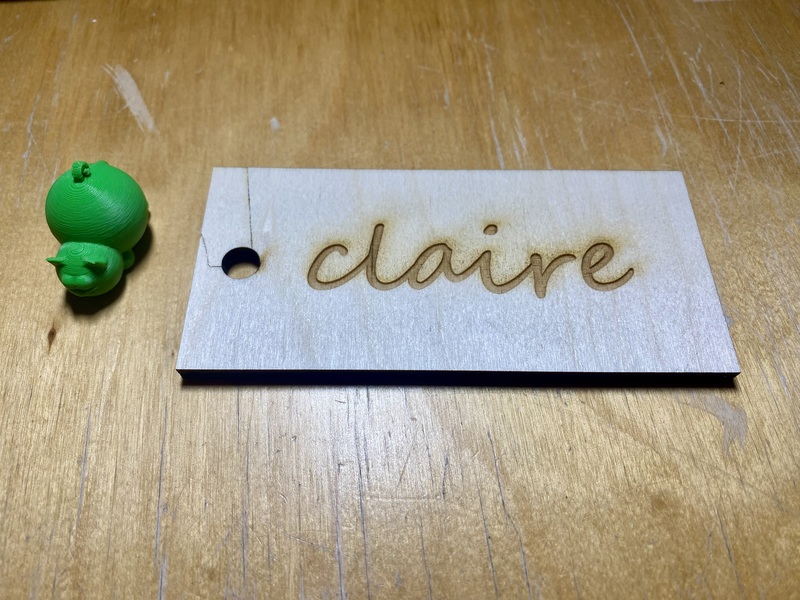
You would think I should get training for 3D printing, as someone who has never touched a 3D printer before and will need to 3D print for this project. So that’s what I did! After trying and failing to get a Metropolis Digital Fabrication Training spot (somehow registration is always full…), I finally got it. Unfortunately, it was not a first-year only training, which meant I did not receive the free toolbox you’d normally get, but I did get a cute 3D-printed cat out of it, as well as a wooden laser-cut piece of my sister’s name that was supposed to be keychain-sized but ended up being a little too large.
At this point, the artist in me was fangirling to no end. I’m pretty well-versed in any 2D medium of art you can think of, so these tools for 3D design were incredible to use for the first time. I might even get the manual training later, both to actually get the toolbox and to explore fabrication more, even though my MechE Lead told me the manual part wasn’t actually necessary to our project.
Conclusion: I’ve basically rewired my entire life
The short-term conclusion: I need to lock in on my project. My teammates are locked in, I have a co-designer patiently waiting, and we have every ability to finish by the end of the semester.
The long-term conclusion: maybe I’ll supplement my intended Course 18 major with Electrical Engineering with Computing (Course 6-5). Perhaps mechanical engineering with a concentration in Control, Instrumentation, and Robotics (Course 2A-CIR) if I’m brave enough, but I’ve already sunk time into classes that would satisfy Course 6 requirements, so it’s 6-5 for now. It’s not the usual combination of math and Computer Science and Engineering (Course 6-3) or AI and Decision-Making (Course 6-4) but somehow it feels right, more exciting. It feels like answering that urge to build, to create, rather than sticking to programming, which is largely limited to the screen and not what I can move and fidget with in front of me. Why would I ever settle for software when I could build whole physical and hardware systems?
I want to build things. I have never built anything in my life before, but I am building things now. Until two months ago, I wasn’t familiar with any tools beyond a pencil and paper, blackboard and Hagoromo chalk — but now I can’t wait to see where I’ll go.