Pulitzer Prize-winning author Siddhartha Mukherjee explores the future of cancer research
Mukherjee discusses the future of trust in science at Museum of Science





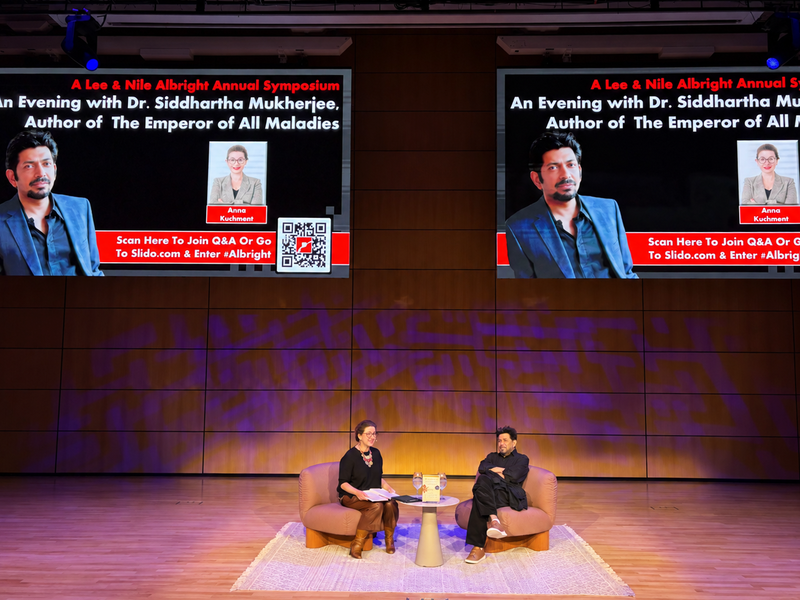
Photo courtesy of Ananya Raghu
On Sunday, Nov. 8, Pulitzer Prize-winning author and cancer researcher Siddhartha Mukherjee spoke at the Lee & Nile Albright Annual Symposium at Boston’s Museum of Science, discussing advances in cancer biology, the emerging role of artificial intelligence in medicine, and the importance of public trust in science.
The conversation, moderated by Anna Kuchment KSJ ’22, health and medical editor at The Boston Globe, was held as part of the Lee & Nile Albright Annual Symposium and served as the culminating event of the museum’s Trust in Science Community Day. Organized in partnership with MIT Press, the daylong program featured panel discussions and a book fair exploring the relationship between scientific discovery and public trust.
Mukherjee, whose 2010 book The Emperor of All Maladies: A Biography of Cancer won the 2011 Pulitzer Prize for General Nonfiction, has spent much of his career bringing complex medical discoveries to a broader audience. His subsequent books, The Gene: An Intimate History and The Song of The Cell: An Exploration of Medicine and the New Human, explore the scientific discoveries and human stories that have shaped modern biology.
A changing understanding of cancer
During the evening discussion, Mukherjee reflected on the remarkable advances in cancer treatment since the publication of The Emperor of All Maladies in 2010. At the time, many emerging immunotherapies, which harness the immune system to fight cancer, remained largely experimental. Today, treatments such as CAR-T cell therapy have become clinical realities.
Mukherjee expressed particular enthusiasm about emerging research into the relationship between inflammation and cancer development. Scientists have long understood that the accumulation of genetic mutations drives cancer. However, Mukherjee described evidence suggesting that certain forms of chronic inflammation may also play a role in enabling already-mutated cells to develop into tumors. He explained that some cells may harbor potentially cancer-promoting mutations while remaining dormant. Particular inflammatory conditions could then create an environment that allows these cells to proliferate and acquire additional mutations.
“The world of cancer is going through a seismic shift,” Mukherjee said, emphasizing the potential implications of this evolving understanding for early detection and prevention. He suggested that identifying particular forms of inflammation associated with cancer development could eventually offer new opportunities for prevention.
Mukherjee also discussed growing interest in liquid biopsies, which aim to detect signs of cancer through biomarkers such as tumor DNA circulating in blood samples. While promising, he cautioned that even highly sensitive screening tests can produce misleading results when used indiscriminately.
Drawing on Bayesian statistics, a mathematical framework for updating the probability of an event based on new evidence, Mukherjee explained that the likelihood of a positive result indicating actual cancer depends not just on a test's accuracy, but also on the prevalence of cancer in the population being screened.
“Medicine is a fundamental Bayesian problem,” Mukherjee emphasized. He argued that incorporating information such as family history and other clinical risk factors could make screening considerably more effective.
Artificial intelligence and the future of medicine
Another major focus of the symposium was artificial intelligence, which Mukherjee described as an increasingly powerful tool in medicine. He highlighted three broad applications of AI: informational, diagnostic, and therapeutic AI.
The first, informational AI, involves navigating vast bodies of medical literature to support clinical decision-making.
“If I was a patient, and my doctor was not using AI, I would not trust that doctor,” Mukherjee said, highlighting the growing importance of these tools in clinical practice.
He described a rare case involving a patient with aggressive lymphoma and latent tuberculosis, in which physicians needed to determine which condition to treat first. With only a handful of relevant cases documented in the literature, AI could help rapidly retrieve evidence that might otherwise take physicians considerable time to uncover.
The second application focuses on improving diagnosis and predicting treatment responses. Mukherjee pointed to breast cancer screening, where AI-assisted mammography combined with radiologists’ expertise can outperform either approach alone. He also described the role of AI in analyzing medical scans to identify characteristics of the thymus, an organ involved in T-cell development, that could help predict which patients are most likely to respond to immunotherapy.
Finally, Mukherjee discussed AI’s potential to transform drug discovery, drawing on his work developing therapeutics through generative chemistry. He compared drug molecules to keys designed to fit specific protein locks. Rather than screening enormous libraries of potential compounds to find a key that fits a particular protein lock, AI can help researchers design new molecular keys tailored to the shapes and chemical properties of their targets.
Rebuilding public trust in science and the art of communicating science
Mukherjee emphasized that, while scientific advances offer new hope for improving medical care, progress in medicine must be accompanied by public engagement. Discussing growing skepticism toward scientific institutions, he argued that researchers should respond to criticism with openness rather than dismissiveness. He encouraged scientists to engage directly with those who question scientific findings and to recognize skepticism as an opportunity for constructive discussion.
“Expertise comes with responsibility,” Mukherjee said.
In an exclusive interview with The Tech in the green room before the symposium, Mukherjee reflected on his career as a science writer and physician, describing the close relationship between scientific storytelling and the practice of medicine.
Science writing, he suggested, offers one way for researchers to engage with the public. Asked what initially drew him toward the field, Mukherjee reflected on the need to connect scientific discoveries with the human experience of medicine.
“I think I was responding to a vacuum around a very particular kind of science writing,” he said.
Although writers such as British neurologist Oliver Sacks and American surgeon Atul Gawande had explored medicine through patients’ stories and personal experiences, Mukherjee felt there was a growing need for writing that more directly connected the increasingly complex science underlying medical discoveries with the practice itself.
Mukherjee also reflected on how writing about the history of science and the personal experiences of patients has influenced his own approach to medicine. He suggested that engaging with personal histories through writing has helped him become a more thoughtful physician.
“The way that I practice medicine is now much more participatory. It’s much more inclusive,” he told The Tech. “Bringing personal history into medical writing allows you to become a person, and becoming a person makes you a better doctor.”
This approach is reflected in his book The Gene: An Intimate History, in which he intertwines the history of genetics with his family's experiences of mental illness.
When asked what advice he would offer students interested in communicating science, Mukherjee emphasized the importance of treating writing as a craft that demands both technical mastery and respect for the audience.
“You have to find the precise tone,” he explained, cautioning against speaking condescendingly to readers.
He also argued that effective science writing begins with a thorough understanding of the material. Without that foundation, attempts to simplify complex ideas risk introducing inaccuracies or diminishing the scientific thinking behind them. Mukherjee described the extensive fact-checking that goes into his work, noting that a single article can involve reviewing thousands of scientific papers.
Writing and human creativity in the age of AI
The interview concluded with a discussion of how generative AI might change the future of science writing.
Mukherjee noted a fundamental paradox in AI systems trained on human writing: their capabilities depend on the body of knowledge and creative work produced by people.
“If human beings stop writing and stop thinking, then ChatGPT itself, the whole idea of the corpus [of data used to train AI models] will come to halt,” he said.
While acknowledging that AI is increasingly capable of generating its own ideas and hypotheses, Mukherjee emphasized the continued importance of human participation in the creative process.
“I like to think that it’s a collaborative process, and that if we stop collaborating with AI, AI will stop collaborating with us,” he told The Tech.
Earlier in the symposium, Mukherjee had been asked whether he envisioned a future without cancer. His answer was no: cancer is woven into the very biology of human life, arising from mutations in the same genes that allow cells to grow and repair themselves. Nonetheless, he remained hopeful that scientific advances could continue to reduce cancer mortality.
Perhaps the same enduring quality can be found in the human impulse to write and make sense of the world. Even as the technologies of medicine and storytelling evolve, the curiosity that drives both remains fundamentally human.