Taking flight without leaving a trace
Olivier Kigotho MS ’24 PhD ‘27 on making aviation safer for the environment





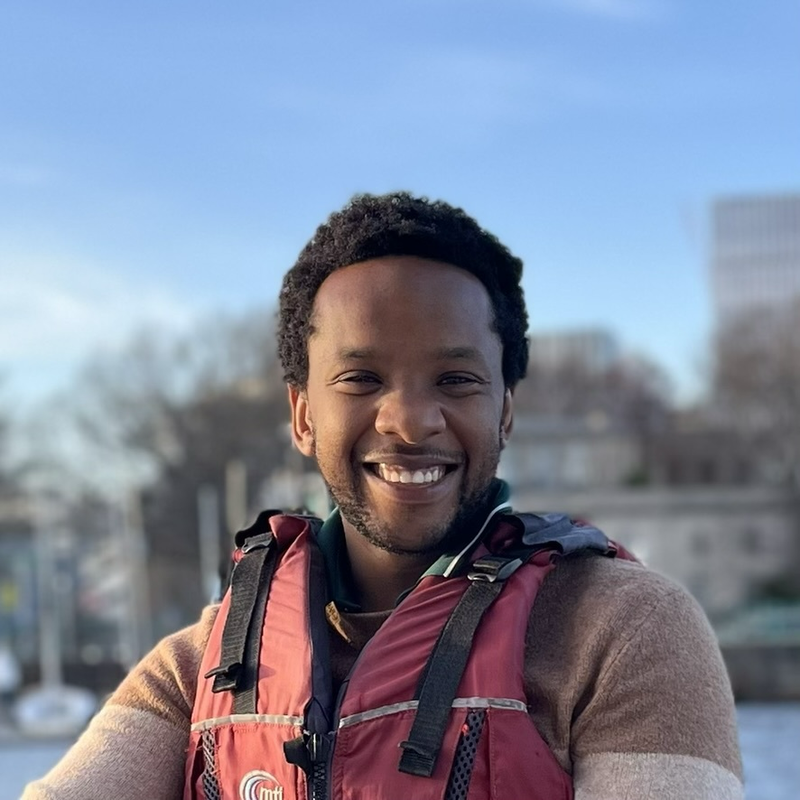
Malakhi Beyah–The Tech
Next time you go outside on a clear day, look up. You will probably catch a plane or two soaring through the sky, and chances are that they will leave thin white clouds that persist long after the planes leave your field of view. Those white clouds are condensation trails (or “contrails” for short), which form when a plane engine’s hot and humid engine exhaust freezes as it is exposed to the cold air high in the atmosphere.
These artificial clouds have been a known artifact of aviation since the early 1900s. However, it was not until the end of the century that researchers discovered the harmful nature of contrails: according to multiple studies, each little cloud has a net warming effect.
Olivier Kigotho MS ’24 PhD ’27 has spent the past five years researching a way to reduce the aviation industry’s harmful environmental impact. In an interview with The Tech, Kigotho explained the motivation behind his studies, as well as how his lab has navigated obstacles that have jeopardized their research.
This interview has been edited for length and clarity.
The Tech: You study aeronautical engineering, which covers a large number of disciplines. What inspired you to focus on reducing contrails’ environmental impact?
Kigotho: I’ve always been passionate about aviation. When I was a child, I used to make my mom drive me to the airport to watch the planes. So when I started doing research as an undergrad, I knew that research was what I wanted to do, and I looked to apply to graduate programs that do aviation sustainability all over the US. This lab, the MIT Lab for Aviation and the Environment, is one of the few places that actually has that.
Contrails have a large greenhouse effect: something like half of aviation’s climate impact so far as come from contrails. My research is on predicting where contrails are likely to form and persist: that’s basically predicting what parts of the atmosphere are very humid. I’ve been using existing weather forecasts and trying to improve them using geostationary satellite images of where we can see contrails.
I started focusing on contrails when I first joined the lab, and at the time, I didn’t know much about them. But they are a unique opportunity to mitigate aviation’s climate impact. If you think of other pathways to create green aviation, there are sustainable fuels, there are new technology developments (like aircraft technology and making planes more efficient), and then there are contrails. Getting sustainable fuel at scale is something that’s extremely challenging to do, both because of the cost and because of the supply chains, so that’s not something as feasible in the near term. With new technology, it takes a long time to develop and certify a new aircraft. So if you develop an aircraft today, it may not become the dominant aircraft in the fleet for another 30 years, and that’s longer than the timescale of climate change.
Contrails are a unique opportunity because you can avoid them operationally. The regions where contrails form, persist, and form larger clouds are thin in the vertical direction; you can think of them sort of like a pancake shape in the atmosphere. We can change aircraft altitude by 2,000, 4,000 feet, and then avoid a large number of contrails that could have a large climate impact.
TT: In your time working on this project, have there been any obstacles that have changed the way you have gone about your research?
Kigotho: The Trump administration has come in and stalled a lot of sustainability funding, including most of our grants through the Federal Aviation Administration (FAA). The biggest change has been in lab funding; our lab hasn’t admitted new grad students in three years. That’s made me realize I have more work to do, just because I don’t have as many collaborators as I would have had if there were more graduate students.
That’s both an opportunity and a problem. It’s an opportunity because I feel like I have more space to make an impact because I’m one of the few people left working on the project that I started on, but it’s a problem because getting the best science done and getting the best research done requires having a team. We still do have a team; it’s just smaller than it would have been otherwise.
Also, it’s a bit challenging being in a field where there are so many conspiracy theories. A few months ago, I saw someone on TikTok that had both the science [saying that contrails have a large climate impact], and the conspiracy theory [that contrails are bad for people’s health] in the same video. I think it’s important to communicate to the public that, no, there’s not a conspiracy to do mind control through contrails, but they do still have a bad climate impact.
TT: From what you’ve told me, adapting to change has been a large part of your graduate experience. Were there any undergraduate experiences that taught you how to manage such pivots?
Kigotho: Growing up, I always played tennis. I played for the Kenya national team, and I traveled around competing. That was most of my life. In my first year of undergrad, I was at the University of California, Riverside, and I played tennis there.
I think my perspective as an athlete helped shape my academic career. My journey hasn’t been without hurdles, and there are times when I feel like the research isn’t going well or it’s uncertain whether I’ll have funding or whether the project will be able to continue. And in those moments, I lean on something my tennis coach told me when I was 15 years old: we can’t always control what’s happening in the world around us, but it’s our job to do the best that we can to give ourselves a chance to succeed. We won’t always succeed, but we can at least, at the end of the day, know we gave ourselves that chance.
When I decided to stop being a competitive athlete after my first year at UC Riverside, I thought, “Let me give myself a chance and apply to a variety of places.” I was very grateful to get into Tufts University, where I had very good mentors like Professor Jason Rife. During the pandemic, I did research on bird flight and flying wings, as well as navigation for self-driving cars. I think that’s when I fell in love with the research process, and then having that research experience, I think, is what made me a strong candidate to apply to graduate schools.
[For current undergrads considering research, know that] you don’t have to be certain! There are many things that someone can do; I chose to do research because I knew that was something I wanted to do, but I still have friends from undergrad who chose different paths, and I think have also been very fulfilled in the paths that they chose. So in the same way that I had to reinvent myself from being an athlete in undergrad to someone who’s an academic now, I don’t know what I’m going to do next.
Hopefully, if you’re an undergrad at MIT, you have the opportunity to pivot and try something new. I think that helps take off the pressure of, “Oh, who am I going to be when I graduate?” You don’t need to know; it’s not final. There are additional hurdles when you pivot, and you have to recognize that, but it’s part of the process.
For undergrads who are applying to graduate school, I think it’s important to think about what your advisor is like and whether you’ll get along with them. Sometimes you can find an advisor who does really interesting research that you may be passionate about. But if your interpersonal dynamic with them isn’t great, then it can lead to a pretty miserable experience. I’ve been fortunate enough to work with [Vice President for Research and Jerome C. Hunsaker Professor of Aeronautics and Astronautics] Ian Waitz as my advisor, and he has been very good. So I’ve had a positive experience in that regard, and it’s part of why I’m continuing to do my PhD here.