Contentious UA debate follows recent budget controversy
On the ballot are three tickets: Abdelbarr-Garfi, Jones-Barnett, and Lipkovitz-Donegan





Levy Le–The Tech
Levy Le–The Tech
Levy Le–The Tech
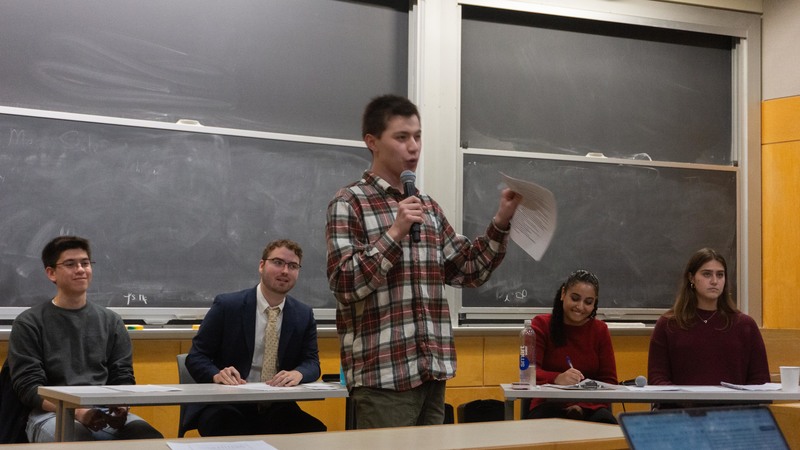
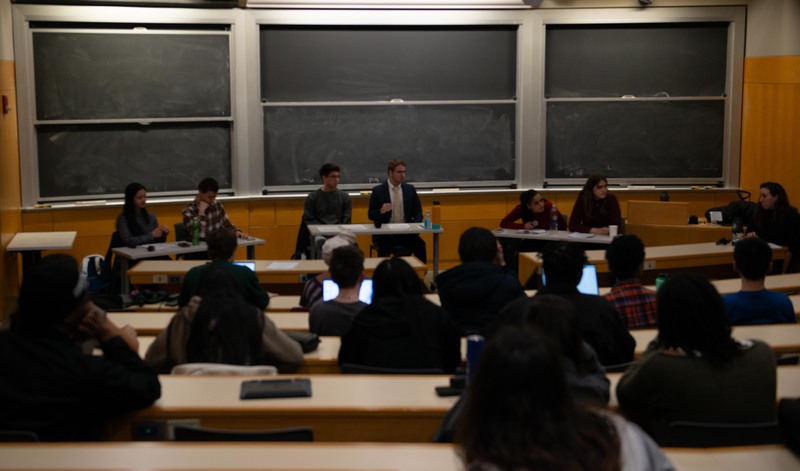
On March 16, the Undergraduate Association (UA) Elections Commission held a debate for UA Presidential and Vice Presidential candidates Mariam Abdelbarr ’27 and Francesca Garfi ’29 (Abdelbarr-Garfi), Johnnie Jones VI ’27 and Matthew Barnett ’27 (Jones-Barnett), and Rivka Lipkovitz ’29 and Anthony Donegan ’28 (Lipkovitz-Donegan) in Room 4-231 and over Zoom.
On March 12, Lipkovitz resigned from the election via dormspam, but remained on the ticket to allow Donegan to run. If their ticket were to win, Lipkovitz said she would “probably resign,” but expressed interest in staying involved with the UA as Vice President or Treasurer.
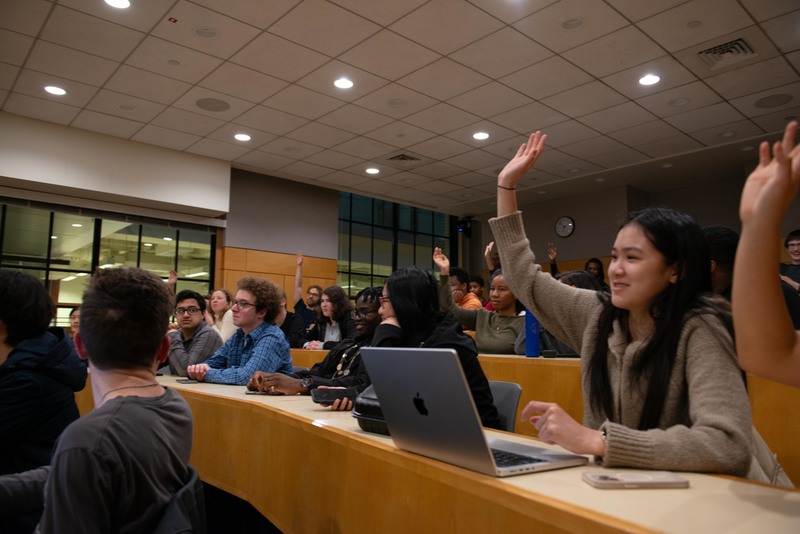
Concourse Program Assistant Director Sasha Rickard ’19 moderated the debate. Following the recent UA budget controversy, around 40-50 people attended the debate in person, while the Zoom livestream hovered around 56 viewers.
Abdelbarr, the current UA Vice President, stated that she would continue the work of the current UA administration while committing to increased transparency and fresh perspectives. Meanwhile, Jones-Barnett and Lipkovitz-Donegan voiced frustration with the current UA administration. Jones-Barnett emphasized the detailed plans they’ve already developed to enact reform and empower students. Lipkovitz-Donegan, on the other hand, proposed restructuring the UA into a direct democracy.
On the UA’s purpose
Lipkovitz-Donegan asserted that the UA should represent the student body and its issues to the MIT administration in a direct democracy format. He said that he would not “claim to know what the average MIT undergrad wants,” but emphasized his desire to take note of every individual issue. He even stated he would walk to President Sally Kornbluth’s office and present student concerns directly.
While Jones-Barnett agreed with the need to promote student advocacy, they took a more moderate approach. Instead of “taking voices directly up” to Kornbluth, Jones would prioritize input from the entire student body to “create the change that students want to see.”
Meanwhile, Abdelbarr-Garfi noted that the UA’s responsibilities go beyond funding. “[The UA is] also about advocacy, building community, and making sure students feel heard and supported,” Garfi said.
On concrete plans
The Jones-Barnett ticket asked if any of the other candidates had put out a “specific, concrete plan for their administration.” As of time of publication, they are the only candidates to have posted their plans in writing.
Donegan responded that he had not been able to publish a detailed platform, as the UA Election Commission had banned him from campaigning for the Lipkovitz-Donegan ticket due to premature campaigning. Despite his lack of a formal platform, Donegan stated he would fight for the people of MIT and the issues they care about.
Abdelbarr reiterated her plan to publicize town halls and increase student participation to draft the UA budget, as well as continue interfacing with administration.
On interactions with the MIT administration
Jones-Barnett plans to build a relationship with MIT’s faculty leadership, stating that a healthy dynamic has always been key to policy change at the Institute.
Lipkovitz-Donegan reasserted their desire to reference primarily student input when meeting with MIT administration. “There are issues that students are very passionate about,” Donegan said, “and I believe that I can be the loudest voice in the room.”
Abdelbarr-Garfi affirmed the importance of student input, but Abdelbarr noted the infeasibility of bringing every issue to Kornbluth. She instead highlighted previous surveys and canvassing efforts. One example is the UA’s Participatory Budgeting initiative in December.
On the UA’s budget
Abdelbarr-Garfi was the first to answer the major question concerning the annual UA budget. Abdelbarr hopes to open the budget drafting process to any interested students and increase transparency around the people voting for the UA’s budget.
Jones-Barnett seeks to promote budget transparency by simplifying and publicizing it, as well as creating a “UA treasury” responsible for keeping the budget updated and balanced.
Lipkovitz-Donegan echoed the other candidates’ proposals, highlighting their plan to publicize every step of the process; Donegan expressed his desire to “make sure that the money goes back to the people.”
Lipkovitz brought up the Harvard UA’s (HUA) budget, noting it is roughly one-fifth the size of MIT’s, and questioned the need for such a large UA allocation. For the 2024-2025 fiscal year, HUA was allocated $541,171.33, with $457,380.59 for clubs. For 2025-2026, MIT UA’s budget is $332,767.40, with $145,000 of this year’s budget coming from the One Fund and the rest coming from reserves. However, the UAs are structured differently and allocate their money to different areas on a line-by-line basis.
Abdelbarr pointed out that the UA gets a small cut of the student life fee — three percent. As a first step, Abdelbarr said she would educate students about the budget and encourage them to offer input at council meetings. However, she would also consider reallocating the funds if needed.
Jones believes the UA does not require its current budget, but cited student programming, support for food insecurity, and resources for students traveling as justifications for how those funds could be used. He would prefer to maintain, and even increase, the current budget if the UA starts doing “really good work that serves students.” Barnett added that comparisons between Harvard and MIT are unfair, as they are two different universities operating in different contexts.
In response to Lipkovitz’s claim that the UA does not fund clubs, UA President Alice Hall ’26 stated that the UA has allocated thousands of dollars this year, such as through the Community and Diversity Fund.
Cayetano “Guy” Sanchez IV ’27 asked the candidates to commit or not commit to a spending cap on retreats and internal bonding, and for how long if so.
Donegan emphatically stated zero dollars. Jones stated no more than five thousand.
Abdelbarr said it would be difficult for students to make every decision without planning beforehand, adding that the retreat helps train UA members and support committee retention. Nonetheless, she is willing to accept any spending cap that students vote on.
On student input
Donegan believes the UA should directly ask students what they want the money to be spent on instead of asking students to come to them. Abdelbarr countered that such an approach could be biased toward certain voices and proposed that it would be better to strengthen the bond between students and their representatives, while further publicizing council meetings. She added that Donegan’s plan is great in theory and “completely infeasible” in actuality.
Rinoa Oliver ’28 asked Abdelbarr how people would have time to show up to council meetings, citing Abdelbarr’s previous statement about students being busy with psets.
Abdelbarr said interfacing with students is great when they are available, but that ultimate decision making is “more effectively” done by representatives. She also explained that helping students connect with their representatives will ensure their ideas are presented in council without having to show up themselves. “The representatives help dilute the fact that not every single student has to show up to everything,” she concluded.
On promoting civility
UA History Co-Chair Geoffrey Enwere ’26 asked how each candidate would create a positive working environment in the UA.
Abdelbarr would make sure the blame does not fall on a “centralized power” and pointed to current systems in place for students to share their concerns.
Jones stated his ticket would cooperate with student leaders and restructure the UA’s interactions with organizations to serve people the way they want. “The way that happens is through good relationships,” he said.
“I'm happy to work with any student government leaders that are happy to work with me,” Donegan said. He reiterated that none of the things he or his friends said on dormspam were personal attacks, which he strongly condemns.
On restructuring the UA’s finances
Former UA President Enoch Ellis ’26 asked whether the candidates would create a solicitor general position within the UA to audit its finances. All candidates expressed support; Jones-Barnett had already proposed such a role, Abdelbarr called it “very appropriate,” and Donegan said he would “gladly” do it himself or appoint someone else.
Abdelbarr was asked why she did not pursue reforms if she believed the transparency around UA finances were inadequate when she entered office. She was also asked why students should trust her to deliver on her campaign promises for financial transparency and to navigate future conflicts.
As vice president, Abdelbarr said her priorities were advocacy and working with admin; however, she acknowledged that UA finances were not fully transparent and accepted accountability for the lack of clarity. She added that she wants to continue listening to both administrators and students to make improvements.
On leadership and delivering on promises
With just a few minutes left, the candidates were asked why students should trust them to deliver on their plans and about their leadership experience.
Donegan is the president of Student House and speaker of the living group council; in the past, he was DormCon REX/CPW Chair and briefly on the Student Group Funding Council.
Jones has been a part of FPOP leadership and helped develop Project Interphase; Barnett is the head alter server for the MIT Tech Catholic Community, the vice president of New Vassar, and the Chief Operating Officer of MIT Model UN.
Abdelbarr is the vice president of the UA and volunteers at hospitals and elementary schools; Garfi is involved with Camp Kesem.
Each ticket also received a specific question: for Abdelbarr, how many coffee chats the UA went on and the administration’s effectiveness following the revocation of spending IAP flex dollars outside the Student Center; for Jones, how his proposal would avoid more bureaucracy; for Donegan, if he previously raised concerns to UA leadership.
Donegan said he did not discuss the budget beforehand; rather, he “immediately publicized” it upon receiving it from an unspecified UA member. He asserted that his commitment despite the “all the controversy” demonstrates he will stick by his promises.
Jones-Barnett has already started gauging their proposal’s feasibility by talking to various sources, including the UA’s former advisor.
Abdelbarr estimated the UA went on “hundreds” of coffee chats and clarified that restrictions on IAP flex dollars came from admin decisions. She added that the UA has been working on this issue and hopes for change next year.
Moving forward
Voting is now open and closes at 5 p.m. on Saturday, March 21. Results will be announced by 10 p.m. on Sunday, March 22.
Matthew Barnett ’27, a UA Election candidate, is the Sports Editor of The Tech. Geoffrey Enwere ’26, who participated in the debate as an audience member, is a Senior Editor of The Tech. Neither was involved in the reporting or editing of this article.