Dr. Yiqiao Zheng uses her multidisciplinary expertise both inside and outside of the lab
The current President of the Postdoctoral Association has changed fields twice, and she has thoughts on how science is conducted





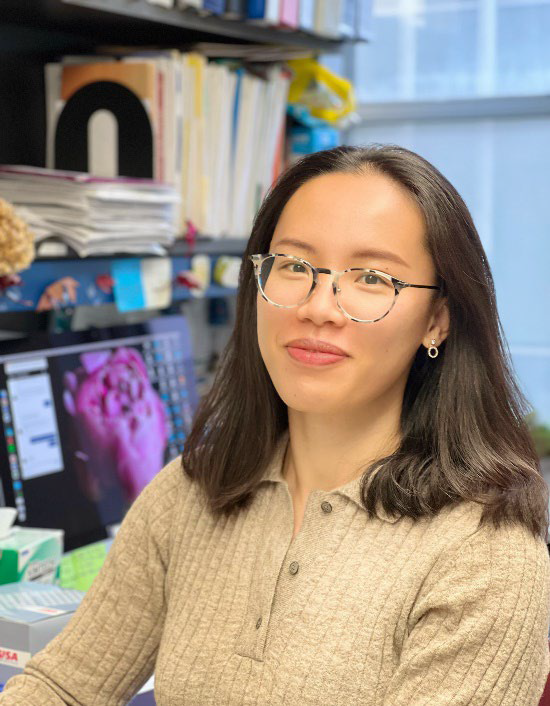
Photo courtesy of Dr. Yiqiao Zheng
From developing new biotechnology to documenting genetic blindness to analyzing cellular division in a very peculiar fungus, Yiqiao Zheng PD has worn many hats in her scientific research career. Now, as the president of the MIT Postdoctoral Association (PDA), she uses her experience to bring together a community that could otherwise feel isolated.
Finding (and filling) the gaps
Between her undergrad, PhD, and postdoc, Zheng has switched fields two times: she originally started as a biomedical engineering student at Hong Kong Polytechnic University. However, she felt like there was something missing in her work.
“We always claim that this new tool is going to solve this medical problem,” Zheng said. “So then I have this question: is it true that the problems that we claim are being solved by our technology are actually being solved?”
To get a better understanding of what technology can do for medicine, Zheng entered a PhD program in genetics and genomics at the Washington University School of Medicine in St. Louis. Her project focused on genetic mutations that cause blindness by disrupting the function of the retina, the cells in the back of the eye that reflect light to process images. She ended up writing a review paper summarizing 25 years’ worth of retinal blindness research and curating a database of the mutations in all known blindness cases.
The database gives people at risk for developing blindness more information and more options. “They can look up our research and say, ‘Hey, so I have this variant in this gene at this location; can I predict what my condition will be and then can I seek medical assistance early on?’” Zheng explained.
Towards the end of her PhD, Zheng’s advisor began clinical trials to expand screening for blindness-causing mutations and work towards treating the condition with gene therapy. “That really brought me to a position where curiosity-driven research is good, but the goal really is trying to use the knowledge that I generate to help people,” she said.
But she didn’t stop there. Because of the competitive nature of the genomics field and her desire to understand biology on a cellular level, Zheng switched fields again after her PhD — this time, to fungal biology.
A very “fun” fungus
After attending a seminar by Professor of Biology Daniel Lew — Zheng’s current mentor and supervisor — as a graduate student, Zheng began a postdoc studying a special fungus called Aureobasidium pullulans.
A. pullulans interested Zheng for a number of reasons. First of all, it’s ubiquitous: scientists have documented the fungus’ survival everywhere from oceans to plants to even Antarctica. How it does that is still a mystery.
The fungus also has a special reproductive process. Typical cell division occurs through a carefully choreographed process called mitosis, in which all of the cellular components are duplicated and then segregated onto opposite sides of a mother cell. The mother cell then divides in half, creating two identical daughter cell copies. But instead of dividing into two daughter cells, A. pullulans can break into multiple daughters at once.
“Do all the daughter cells inherit a similar amount of the materials they need to survive? If so, how does the cell do that? If not, then what is the mechanism?” Zheng asked.
Zheng credits Lew with navigating decreases in funding for biological research in a way that still gives her a chance to pursue the questions that she finds exciting.
“His work has always been driven by curiosity, not by funding sources or what other people wanted to do. I personally think it’s a privilege that actually brought many unexpected discoveries,” Zheng said.
Tackling old problems in new ways
Zheng’s experience across many fields of biology allows her to see the institution of science from more angles. “It helps me understand the system better, because I have a new or different perspective,” she said. “It really creates an opportunity to answer a new question with an innovative approach.”
This interdisciplinary approach to solving problems also helps Zheng run the PDA. Zheng joined the PDA last year when she began serving as the Community Building and Committee Chair. Her task of connecting postdocs was especially challenging because they don’t enter MIT as a single cohort and don’t necessarily take classes, giving them few chances to interact.
“People have always told me that they feel isolated working as a postdoc here,” she recalled. “That’s when I decided I wanted to do something to build a community.”
Though Zheng has heard that her work has brought postdocs together, her job has become even harder as some academic departments are forced to downsize diversity-related programs due to lack of funding.
Her progress in the role is what led Zheng to become the president of the PDA. Now, her focus is more on understanding belonging on campus, with the PDA planning on releasing a postdoc-specific belonging survey next year.
As president, Zheng has taken on the responsibility of advocacy. “Across the board, postdoc fellows are not recognized as employees, so they don't have many of the employee benefits,” including medical insurance and childcare, Zheng explained.
She’s also advocating for better working conditions, like better-functioning Internet, which can play a huge role in how long certain research processes take. “Many postdocs have told me that they have this feeling that when they come to MIT that it’s already an honor or privilege for you to have you come to MIT,” Zheng stated. “But then we sometimes feel we are not supported enough.”
Though Zheng notes that her departments’ administrative team is very helpful and efficient, she has colleagues whose admin has been much harder to reach.
“If other schools are doing better and better supporting their trainees, then I think one day, MIT will lose its talents because of ignoring so many of the things that they take for granted,” Zheng added.